I Gave Up on CPAP — Now What? Your Real Options
You quit CPAP and feel guilty. But your CPAP data is valuable, your options are real, and the path forward is a better-fitting treatment — not willpower.
Reviewed by Dr. Christopher Henninger, DMD
Last updated February 2026
Key Takeaways
- 30-50% of CPAP users abandon therapy within the first 1-3 years — quitting CPAP puts you in the majority, and your experience is clinical data, not personal failure.
- Your CPAP adherence data — even poor adherence data — is your strongest asset for insurance pre-authorization of oral appliance therapy and other alternatives.
- The oral appliance transition process takes just 3-6 weeks from consultation to wearing a custom device, with 77-90% of patients still using it consistently at one year.
You Did Not Fail — CPAP Failed You
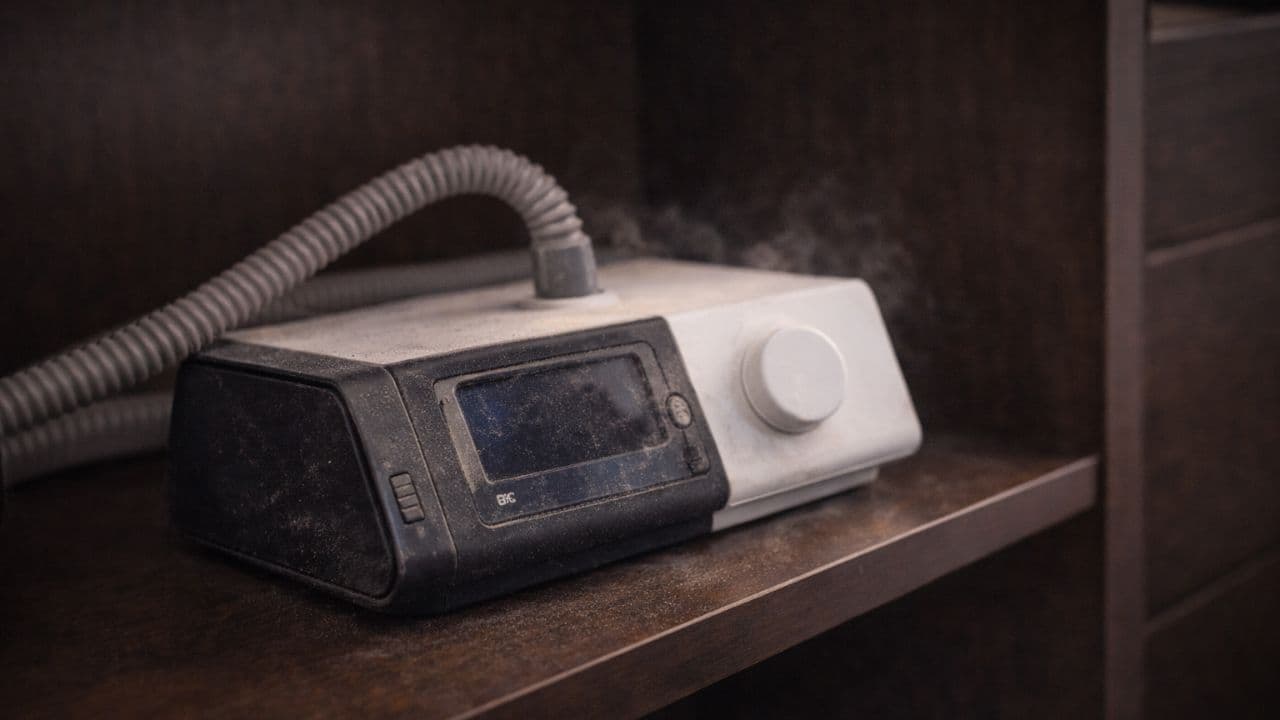
If your CPAP is sitting in a closet, on a shelf, or collecting dust on your nightstand, you are probably carrying guilt about it. Your doctor told you this was the treatment. Your insurance paid for it. Your partner was counting on it. And you could not make it work. That guilt is understandable — and it is misplaced.
You did not fail CPAP. The data shows that CPAP fails a significant portion of the patients it is prescribed to. Your experience is not an outlier — it is the statistical norm.
You Are in the Majority
30-50% of CPAP users abandon therapy within the first 1-3 years. Among those who continue, fewer than half meet the 4-hour nightly minimum. If you quit, you joined the largest patient group — not the smallest.
Tolerance Does Not Always Improve
Despite what you may have been told, CPAP tolerance issues — claustrophobia, aerophagia, mask leak, skin irritation — often persist or worsen over time rather than resolving. Patients who struggle at 30 days frequently struggle at 6 months.
Your Health Still Needs Protection
Giving up on CPAP does not mean giving up on treating your sleep apnea. Your airway still collapses at night. Your oxygen still drops. Your heart still bears the strain. The question is not whether to treat — it is how.
One honest caveat before we go further: some people who quit CPAP were failed by their equipment and support, not by the therapy itself. A poorly fitted mask, an unresolved leak, or a high-volume supplier that handed you a machine and disappeared can sink an experience that better help would have saved. If part of you would give CPAP another try with real support, our CPAP help guides and our advice on choosing a better CPAP equipment supplier are worth an hour of your time. If you are done — read on. Both paths lead to treated sleep apnea, and that is the only outcome that matters.
What Happens Without Any Treatment
This section is not meant to scare you — it is meant to inform you. The health consequences of untreated obstructive sleep apnea are well-documented, progressive, and largely silent until they become emergencies. Understanding them is what makes the next step urgent rather than optional.
Risks of Untreated Sleep Apnea:
- Cardiovascular: 2x higher risk of heart attack, 2-4x higher risk of stroke, and up to 4x higher risk of atrial fibrillation
- Metabolic: Increased insulin resistance, disrupted hunger hormones, and progressive weight gain that becomes nearly impossible to reverse
- Cognitive: Memory impairment, difficulty concentrating, increased risk of depression, and accelerated cognitive decline
- Safety: 2-3x higher risk of motor vehicle accidents due to daytime drowsiness
- Mortality: Severe untreated OSA doubles all-cause mortality risk
These risks do not depend on which treatment you use — they depend on whether you use any treatment consistently. For the full picture, read our article on the consequences of untreated sleep apnea. The point is not to pressure you back onto CPAP — it is to make the case for finding an alternative that actually works for your life.
Your CPAP Data Is More Valuable Than You Think
Before you put that CPAP machine away for good, there is something important you should know: the data on your CPAP machine — even data that shows poor compliance — is clinically and financially valuable. Do not discard it or return the machine without downloading your usage records.
What Your CPAP Data Proves:
- Documented CPAP trial — insurance requires evidence that CPAP was attempted before covering alternatives
- Usage patterns — low hours prove intolerance, which strengthens pre-authorization for oral appliance therapy
- Leak data — high mask leak rates document that the therapy was not being delivered effectively
- Residual AHI — if events remained high despite CPAP use, this supports medical necessity for a different approach
- Multiple mask trials — documentation of mask changes shows that the problem was systematically addressed
- Side effect history — your provider notes about aerophagia, claustrophobia, or skin irritation form the clinical record
Your CPAP intolerance is not a mark against you — it is clinical evidence that opens the door to alternatives. Insurance companies — including Medicare and TRICARE — cover oral appliance therapy specifically for patients who have tried and failed CPAP. Your struggle is your strongest pre-authorization argument.
Treatment Options After CPAP
The good news: you have real, evidence-based options. The AASM recognizes multiple treatment pathways for obstructive sleep apnea, and the right one depends on your severity level, anatomy, and lifestyle. Here is how they compare.
| Treatment | Candidacy | Process | Timeline |
|---|---|---|---|
| Oral Appliance Therapy | Mild-to-severe OSA, especially CPAP failures | Consultation, scan, custom fabrication, titration | 3-6 weeks to wearing device |
| Inspire Implant | Moderate-to-severe OSA, BMI < 40 | Surgical implantation under general anesthesia | 1-2 months recovery before activation |
| Positional Therapy | Mild, position-dependent OSA only | Wearable device or positioning aid | Immediate use |
| Surgical Options | Anatomical obstruction (enlarged tonsils, deviated septum) | Surgical correction under anesthesia | 2-6 weeks recovery |
For a comprehensive look at every alternative, including the evidence behind each, read our article on CPAP alternatives your doctor might not mention.
The Oral Appliance Path
For most patients who have quit CPAP, oral appliance therapy is the most practical next step. It eliminates every mask-related problem — no hose, no noise, no claustrophobia, no aerophagia — while delivering the airway protection your body needs. Here is what the evidence shows.
Consultation and Candidacy Evaluation
A dental sleep medicine specialist evaluates your jaw structure, tooth health, and bite. They review your sleep study and CPAP data to build the clinical case. This is typically a 30-45 minute appointment with digital scans — no impressions or molds.
Insurance Pre-Authorization
Your provider submits a pre-authorization to your medical insurance using your sleep study results plus CPAP intolerance documentation. Your history of CPAP failure strengthens this submission significantly. Most approvals take 1-2 weeks.
Custom Fabrication
Your oral appliance is fabricated from digital scans of your teeth — typically 2-3 weeks. Unlike over-the-counter mouthpieces, a prescription oral appliance is precision-engineered to your specific anatomy and adjustable to optimize airway opening.
Fitting and Titration
At your fitting appointment, the specialist adjusts the mandibular advancement — how far forward the jaw is positioned — and teaches you insertion, removal, and care. Most patients adapt within 1-2 nights, a dramatically different experience from CPAP adjustment.
Follow-Up Sleep Test
After 4-6 weeks of use, a follow-up home sleep test confirms the appliance is effectively reducing your AHI. This objective verification satisfies insurance requirements and gives you and your provider confidence that the treatment is working.
The entire process — from first consultation to wearing a custom appliance — takes 3-6 weeks. For the complete clinical picture, see our comprehensive guide to oral appliance therapy.
The Transition Process
The question patients ask most often is: what happens between quitting CPAP and starting an alternative? The clinical answer depends on your situation, but the practical reality is that most patients who have already quit CPAP are living with untreated sleep apnea right now. The priority is closing that gap as quickly as possible.
3-6 Weeks
Consultation to Fitted Appliance
The oral appliance process moves quickly. From your first appointment to wearing a custom device typically takes 3-6 weeks — a fraction of the time most patients spend struggling with CPAP.
6.5-7 hrs
Average Nightly OAT Usage
Oral appliance patients average 6.5-7 hours of nightly use compared to 4.5 hours for CPAP. Higher usage means more hours of airway protection every night.
77-90%
OAT Adherence at 1 Year
Patients stick with oral appliance therapy at dramatically higher rates than CPAP — because a treatment you can tolerate is a treatment you will use.
90%+
Patient Preference Over CPAP
In head-to-head studies, over 80% of patients who try both treatments prefer oral appliance therapy. The comfort difference is not marginal — it is transformative.
Most PPO medical plans, Medicare Part B, and TRICARE cover oral appliance therapy as durable medical equipment — see our insurance coverage and costs guide for the details. Your CPAP intolerance documentation is the key to smooth pre-authorization.
Taking the Next Step
If you have given up on CPAP, the worst thing you can do is nothing. Every night without treatment is a night your heart, brain, and metabolism bear the full impact of untreated sleep apnea. But the second-worst thing is forcing yourself back onto a treatment that has already proven it does not work for you. The path forward is a different treatment — not the same one with more willpower.
Before You Stop CPAP: If you have not yet fully stopped CPAP, read our article on whether it is safe to stop using CPAP before making the decision. Even imperfect CPAP use provides some protection. The ideal path is starting an alternative before stopping CPAP entirely, so there is no gap in treatment.
If you are ready to explore what comes after CPAP, you have options. Visit our CPAP alternatives page — it is designed specifically for patients in your exact situation. Or take our free 2-minute sleep assessment to see if oral appliance therapy may be right for you.
The fastest way to sort out your specific situation is a free 15-minute phone consultation with Thomas D'Acquisto, our founder with 40 years in sleep medicine. Tell him what you tried, what failed, and what you cannot live with — he will help you map the next step. No pressure, no referral needed.
Quitting CPAP was not a failure. It was data. Now use that data to find the treatment that actually works for your life.
Frequently Asked Questions
Is there an alternative to a CPAP machine?
Yes — several, and they are covered by most insurance when CPAP has failed. Oral appliance therapy is the most common next step: a custom-fitted mouthpiece that holds your airway open with no mask, hose, noise, or electricity, appropriate for mild-to-severe OSA. Other options include the Inspire implant (moderate-to-severe OSA, BMI under 40), positional therapy for position-dependent cases, and surgery for specific anatomical problems. Start by finding out whether you are an oral appliance candidate.
What is life after CPAP like?
For patients who switch to oral appliance therapy, the biggest change is simplicity: no mask, no hose, no noise, no power outlet, nothing to pack for travel. That comfort shows up in the numbers — oral appliance patients average 6.5-7 hours of nightly use versus 4.5 hours for CPAP, and 77-90% are still using their device at one year. The one thing life after CPAP should never include is untreated sleep apnea.
I don't want to use my CPAP anymore — what should I do first?
Two smart first moves — fix or fit. First, spend an hour on troubleshooting: a mask leak, dry mouth, or a bad supplier sinks many CPAP experiences that better support would save. Second, if you are genuinely done, explore your candidacy for oral appliance therapy before you stop — and keep wearing CPAP as much as you can tolerate until the alternative is in place. Either way, download your CPAP data first; it is your strongest evidence for insurance approval.
Will insurance cover an oral appliance if I failed CPAP?
In most cases, yes — and CPAP failure actually helps. Most PPO medical insurance plans, Medicare Part B, and TRICARE cover oral appliance therapy, and documented CPAP intolerance strengthens the pre-authorization submission. Your CPAP machine data showing low usage, high leak rates, or persistent side effects provides the clinical justification insurers need.
How long does it take to switch from CPAP to an oral appliance?
The typical timeline is 3-6 weeks from initial consultation to wearing a custom-fitted device. This includes candidacy evaluation, insurance pre-authorization (1-2 weeks), device fabrication (2-3 weeks), and fitting. A follow-up sleep test at 4-6 weeks confirms the appliance is effectively treating your sleep apnea.