What Is an AHI Score? Understanding Your Sleep Apnea Number
Your AHI counts breathing pauses per hour of sleep: under 5 is normal, 5-14 mild, 15-29 moderate, 30+ severe. Here is what your number means for treatment.
Reviewed by Thomas D'Acquisto, Founder/Director, 40 Years in Sleep Medicine
Last updated February 2026
Key Takeaways
- Your AHI (Apnea-Hypopnea Index) measures how many times per hour your breathing partially or completely stops during sleep — scores of 5-14 indicate mild, 15-29 moderate, and 30+ severe obstructive sleep apnea
- While AHI is the primary diagnostic metric, it does not capture oxygen desaturation depth, sleep architecture disruption, or symptom burden — two patients with the same AHI can experience very different levels of impairment
- Treatment options map to your AHI range: mild cases often respond well to oral appliance therapy, moderate cases benefit from CPAP or oral appliances, and severe cases typically start with CPAP — with oral appliances as an effective alternative for patients who cannot tolerate it
What Is AHI?
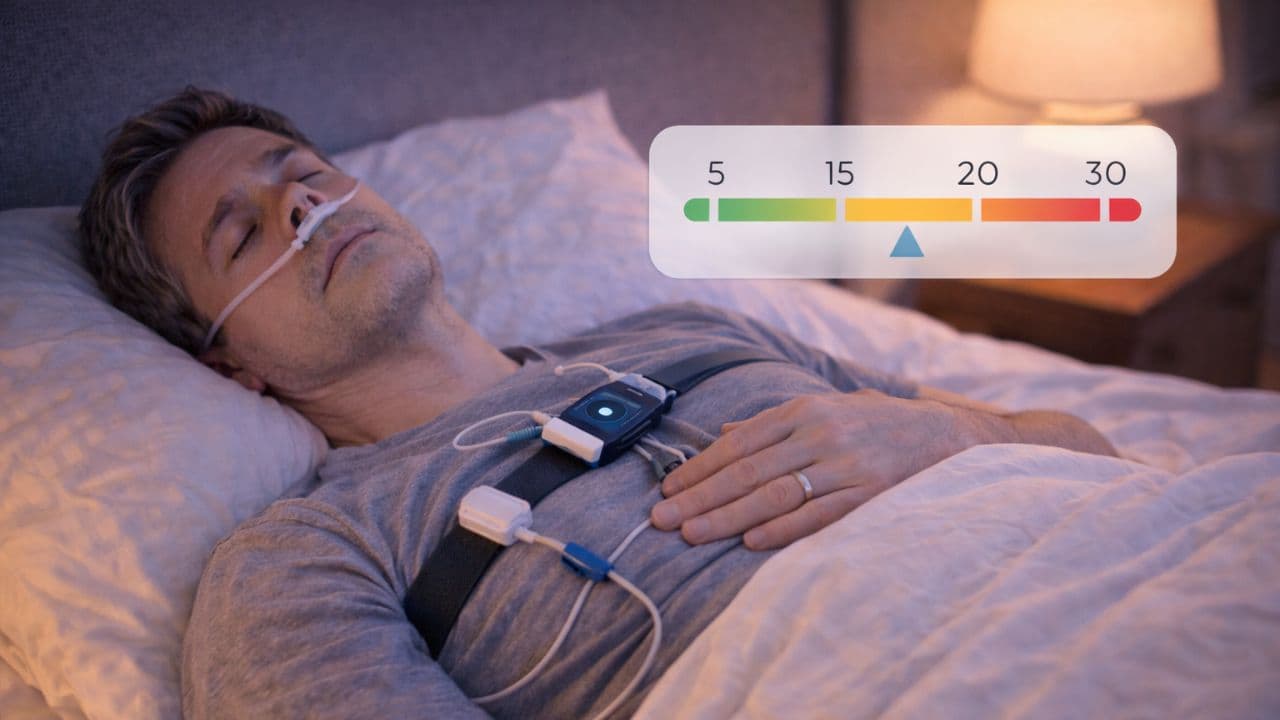
AHI stands for Apnea-Hypopnea Index — the number of times your breathing partially or completely stops per hour of sleep. It is the primary metric used to diagnose sleep apnea and classify its severity: under 5 is normal, 5-14 is mild, 15-29 is moderate, and 30 or more is severe.
If you just got your sleep study back and found this number on the report — maybe your doctor mentioned it in passing, maybe you spotted it on a home sleep test printout — this guide explains exactly what it measures, what your score means for daily life, and which treatments fit each range.
An apnea is a complete pause in airflow lasting at least 10 seconds. A hypopnea is a partial reduction in airflow — at least 30% reduction accompanied by a 3-4% drop in blood oxygen or an arousal from sleep. Your AHI adds these two events together and divides by hours of sleep to give you a single number.
Important context: Your AHI is a diagnostic starting point, not a verdict. Two people with the same AHI can experience very different symptom severity depending on factors like oxygen desaturation depth, sleep architecture disruption, and individual physiology. A "mild" AHI can still cause significant daytime impairment, and treatment decisions should always consider how you feel — not just the number.
How Your AHI Is Measured
Your AHI comes from a sleep study — either an in-lab polysomnography (PSG) or a home sleep test (HST). Both measure the same core events, but in slightly different ways. Understanding how the test works helps you understand what your number actually represents.
Sensors Monitor Your Breathing
A nasal cannula or thermistor tracks airflow through your nose and mouth. When airflow drops by 30% or more (hypopnea) or stops entirely (apnea) for at least 10 seconds, it counts as an event.
Oxygen Levels Are Tracked
A pulse oximeter on your finger measures blood oxygen saturation continuously. Drops of 3-4% or more associated with reduced airflow help confirm that a breathing event is clinically significant.
Effort Belts Detect Breathing Attempts
Elastic bands around your chest and abdomen sense whether your body is trying to breathe during a pause. This distinguishes obstructive events (effort without airflow) from central events (no effort at all).
Brain Activity Records Arousals
In-lab studies use EEG electrodes to detect micro-arousals — brief awakenings your brain triggers to restart breathing. Home tests use movement and heart rate as proxies for these arousals.
Events Are Totaled and Divided by Hours
A sleep technologist or automated algorithm counts every apnea and hypopnea during your study, then divides by your total sleep time. The result is your AHI — events per hour of sleep.
One important distinction: home sleep tests divide events by recording time rather than actual sleep time, since they cannot measure brain waves to confirm when you are asleep. This can underestimate your true AHI — meaning your actual score may be higher than what the home test reports. If your home test shows an AHI near a severity threshold, your doctor may recommend an in-lab study for confirmation.
The AHI Severity Scale
The American Academy of Sleep Medicine (AASM) classifies sleep apnea severity into three categories based on your AHI. These thresholds guide diagnosis, treatment decisions, and insurance coverage.
| Classification | AHI Range | Events Per Hour | Clinical Significance |
|---|---|---|---|
| Normal | 0-4 | Fewer than 5 | No sleep apnea. Occasional breathing pauses are normal during sleep. |
| Mild | 5-14 | 5 to 14 | Sleep apnea present. May cause noticeable fatigue and snoring. Treatment recommended if symptomatic. |
| Moderate | 15-29 | 15 to 29 | Significant sleep disruption. Associated with cardiovascular risk. Treatment strongly recommended. |
| Severe | 30+ | 30 or more | Substantial health risk. Major cardiovascular, metabolic, and cognitive impact. Treatment essential. |
These categories matter because they influence everything from which treatments are recommended to whether your insurance will cover them. For a deeper dive into how each severity level affects daily life and treatment options, see our guide to mild vs. moderate vs. severe sleep apnea.
What Your AHI Number Means Day-to-Day
Numbers on a report are abstract. What matters is how they translate to what you feel when you wake up, how you function at work, and how your body responds over months and years. Here is what different AHI ranges typically look like in real life:
AHI 5-14 (Mild)
You may not feel dramatically impaired, but the signs are there: you need more coffee than you used to, you lose focus in afternoon meetings, and your partner mentions snoring. Many people at this level have been told they are "just tired" or attributed their fatigue to stress. Treatment at this stage can prevent progression and often resolves symptoms that patients did not realize were related.
AHI 15-29 (Moderate)
The impact becomes harder to ignore. Morning headaches, significant daytime sleepiness, difficulty concentrating, and mood changes are common. You may have fallen asleep at a stoplight or during a conversation. Your body is spending a meaningful portion of each night in oxygen deficit, and your cardiovascular system is feeling the strain.
AHI 30+ (Severe)
At this level, your breathing stops at least once every two minutes throughout the night. The fatigue is often profound — patients describe feeling like they never sleep at all. Blood pressure may be resistant to medication, weight gain accelerates, and the risk of serious cardiovascular events increases substantially. Immediate treatment is critical.
Remember: these are general patterns. Some people with an AHI of 8 feel terrible because their events cluster during REM sleep, causing deeper oxygen desaturations. Others with an AHI of 20 feel "fine" because they have adapted to their impaired state over years — they have forgotten what rested feels like.
What AHI Does Not Tell You
AHI is the standard metric, but it has real limitations. Sleep medicine researchers and clinicians increasingly recognize that AHI alone does not paint the full picture of how sleep apnea affects an individual patient. Here is what your AHI number misses:
Oxygen Desaturation Depth
Two patients can both have an AHI of 15, but one drops to 85% oxygen saturation during events while the other only drops to 92%. The first patient experiences far more physiological stress despite having the same AHI. Your sleep study report should include a separate metric called ODI (Oxygen Desaturation Index) and your minimum oxygen saturation — ask your doctor about these numbers.
Event Duration
AHI counts every event equally, whether it lasts 10 seconds or 60 seconds. Longer events cause more severe oxygen drops and greater cardiovascular strain, but a 10-second apnea and a 45-second apnea both count as one event in your AHI calculation.
Sleep Stage Distribution
Events that occur during REM sleep tend to cause deeper oxygen drops and more pronounced heart rate changes. Some patients have a normal AHI overall but severe REM-related sleep apnea — a pattern that is underdiagnosed but clinically significant, especially in women.
Positional Dependence
Many people have significantly more events when sleeping on their back (supine) than on their side. Your overall AHI may be moderate, but your supine AHI could be severe. Positional data on your sleep study can reveal whether simple position changes could reduce your events.
Symptom Severity Disconnect
Research consistently shows a weak correlation between AHI and daytime symptoms. Patients with mild AHI can be profoundly symptomatic, while some with severe AHI report fewer complaints. AHI measures the disease — not necessarily how the disease affects you.
This is why a good sleep medicine provider looks beyond your AHI. Treatment decisions should factor in your symptoms, oxygen data, sleep architecture, and overall health profile — not a single number in isolation.
Treatment Options by AHI Level
Your AHI level is one of the key factors that determines which treatments are recommended — and which ones insurance will cover. Here is how treatment typically aligns with severity:
Mild-to-Moderate (AHI 5-29):
- Oral appliance therapy — a custom-fitted mouthpiece that advances the lower jaw to keep the airway open during sleep
- Positional therapy — devices or techniques to keep you off your back during sleep
- Weight management — a 10-15% weight reduction can decrease AHI by up to 50% in overweight patients
- CPAP — effective at all severity levels if the patient can tolerate consistent nightly use
Severe (AHI 30+):
- CPAP is typically the first-line recommendation due to its effectiveness at higher event counts
- Oral appliance therapy — approved for severe OSA when patients cannot tolerate CPAP
- Combination therapy — oral appliance used with CPAP to reduce required pressure settings
- Surgical options — considered when anatomical factors contribute and conservative treatments fail
For mild-to-moderate sleep apnea, oral appliance therapy has become an increasingly popular choice because of its high adherence rates — patients actually use it consistently. Research shows that a treatment used every night at 80% adherence often delivers better real-world outcomes than a treatment that is technically more effective but used inconsistently. If you want to understand how the two approaches compare, see our oral appliance vs. CPAP comparison, or find out whether you are a candidate for an oral appliance.
Monitoring Your AHI Over Time
Your AHI is not a fixed number. It changes with treatment, weight changes, aging, alcohol use, sleep position, and other factors. Ongoing monitoring matters because it tells you whether your treatment is working — and whether adjustments are needed.
Target AHI on Treatment
The goal of any sleep apnea treatment is to reduce your AHI below 5 events per hour — effectively normalizing your breathing
Follow-Up Sleep Study
Most providers recommend a follow-up sleep test 3-6 months after starting treatment to verify your AHI has reached target levels
Ongoing Check-Ups
Annual assessments ensure your treatment remains effective as your weight, anatomy, and health profile change over time
If you are using a CPAP machine, most modern devices track your AHI automatically and report it through companion apps. For oral appliance users, periodic home sleep tests or in-lab studies confirm the appliance is holding your airway open effectively. Either way, the number should be trending toward that target of fewer than 5 events per hour.
Understanding your AHI is the first step toward understanding your sleep apnea. But a number on a report only matters when it leads to action. If you have not been tested yet, or if your current treatment is not bringing your AHI into the target range, our free sleep assessment can help you figure out the right next step. You can also walk through your sleep study results in a free 15-minute phone consultation with Thomas D'Acquisto, our founder with 40 years in sleep medicine — no pressure, no referral needed.
Frequently Asked Questions
How many apnea events per hour is normal?
Fewer than 5 events per hour is considered normal — occasional breathing pauses happen to everyone during sleep. At 5 or more events per hour, sleep apnea is diagnosed: 5-14 is mild, 15-29 is moderate, and 30 or more is severe. Each event is an apnea (a complete pause in airflow lasting at least 10 seconds) or a hypopnea (a significant partial reduction in airflow).
What is a good AHI score on CPAP?
Below 5 events per hour — that is the target for any sleep apnea treatment, because it effectively normalizes your breathing. Many well-controlled CPAP users see numbers well under that. If your machine reports a residual AHI above 5, your pressure may need adjusting — ask your provider to review your data. And if your AHI is low but you still feel exhausted, look at usage hours and mask leaks next.
What does events per hour mean on a CPAP machine?
It is your residual AHI — the apneas and hypopneas your machine still detects per hour while you are wearing it. Think of it as a nightly report card on how well your pressure is controlling your airway. The goal is fewer than 5 events per hour. A consistently higher number suggests your pressure settings need review, a significant mask leak, or events the machine is not treating effectively.
Is 0.4 events per hour good?
Yes — 0.4 events per hour is an excellent number. It is far below the normal cutoff of 5, which means your therapy is keeping your airway open almost all night. Remember that a treated AHI is only part of the picture: how you feel matters too. If your AHI is 0.4 and you feel rested, your treatment is doing exactly what it should — well-controlled sleep apnea.
Can my AHI score change between sleep studies?
Yes. AHI can vary based on sleep position (back sleeping typically produces higher AHI), alcohol consumption, medication use, nasal congestion, and even which sleep stages dominate a particular night. A single reading does not always represent your typical night. That is also why a normal home test with ongoing symptoms deserves a second look — see our guide to what a negative sleep test result really means.
What AHI level requires treatment?
The AASM recommends treatment for any AHI of 5 or higher when accompanied by symptoms like excessive daytime sleepiness or morning headaches, or for any AHI of 15 or higher regardless of symptoms. Even asymptomatic moderate-to-severe OSA carries increased cardiovascular risk.