CPAP Compliance Rates: Why Half of Users Quit
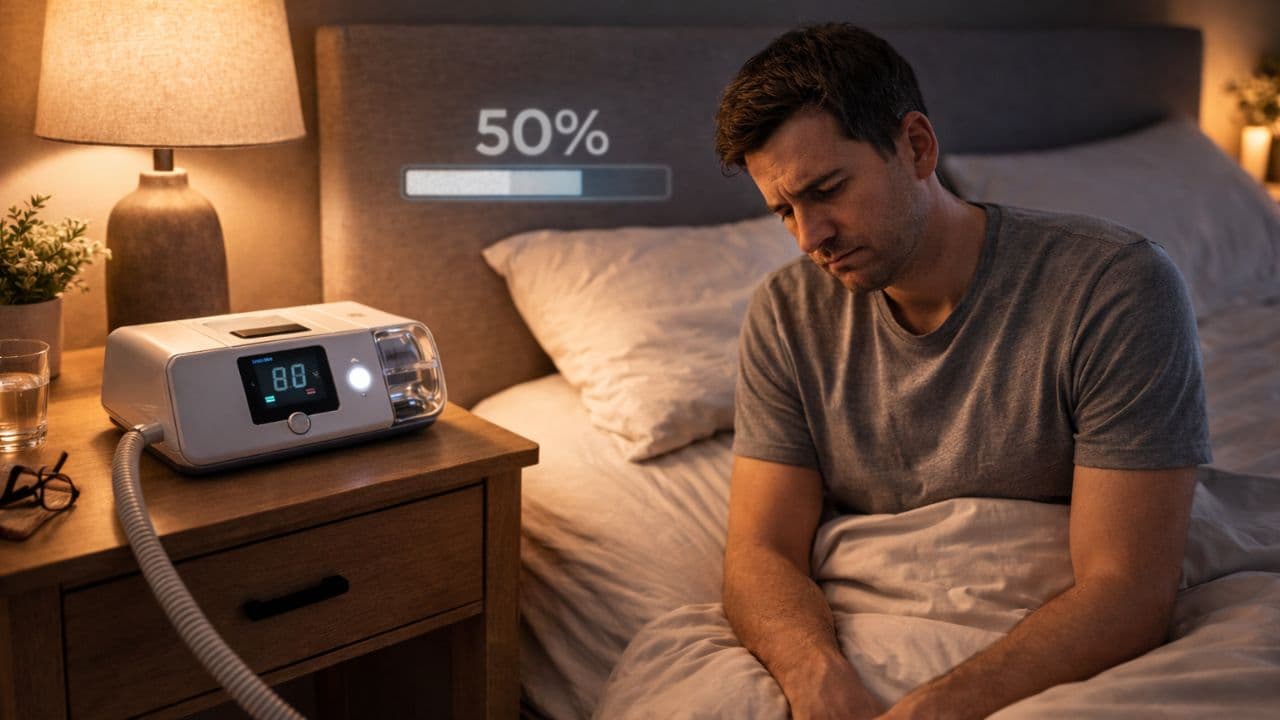
Research shows that 30-50% of CPAP users abandon the therapy within the first year. Here is why compliance is so low and what the data says about alternatives.
Reviewed by Thomas D'Acquisto, Sleep Director
Last updated April 2025
Key Takeaways
- 30-50% of CPAP users abandon therapy within the first 1-3 years, and 46-83% do not meet the minimum 4-hour nightly use threshold.
- Mask discomfort, claustrophobia, air leaks, and lifestyle limitations are the primary drivers of CPAP non-compliance.
- Oral appliance therapy achieves 77-90% adherence at one year compared to 50-60% for CPAP — because patients actually use it.
The Compliance Numbers
CPAP is widely considered the gold standard for treating obstructive sleep apnea — and it works extremely well when used correctly. The problem is that a significant percentage of patients simply cannot or will not use it consistently enough to benefit.
Abandon CPAP
Within the first 1-3 years of use
Non-compliant
Do not meet the 4-hour minimum nightly use
Minimum Threshold
Medicare defines 'compliant' as 4+ hours on 70% of nights
Think about what that 4-hour threshold means: a patient who wears their CPAP for only 4 hours of an 8-hour sleep period is technically compliant — but they are untreated for the other 4 hours. Many sleep physicians consider this definition woefully inadequate, yet even this low bar is missed by nearly half of all CPAP patients.
Why Patients Quit CPAP
Research consistently identifies the same set of barriers that drive patients away from CPAP therapy. These are not minor inconveniences — they are quality-of-life issues that compound over time.
Mask discomfort and poor fit
The most frequently cited reason for CPAP abandonment. Masks cause pressure sores, skin irritation, and red marks. Many patients try 3-5 masks before finding one that is tolerable — and some never do.
Claustrophobia and anxiety
The sensation of wearing a mask with forced air triggers panic in 15-20% of patients. This psychological barrier is often resistant to desensitization techniques.
Air leaks, dry mouth, and nasal congestion
Pressurized air dries out the mouth and nasal passages. Mask leaks spray air across the face and eyes. Congestion forces mouth-breathing, which worsens dryness.
Noise and partner disruption
Even modern quiet machines produce enough noise — especially with mask leaks — to disrupt a bed partner's sleep. Couples sleeping apart due to CPAP is common.
Lifestyle limitations
CPAP requires electricity, distilled water, and a nightstand. It limits spontaneity, complicates travel, and makes camping or field deployment impractical.
Embarrassment and stigma
Many patients feel self-conscious about their appearance with the mask. This affects intimacy and willingness to use the device when sleeping away from home.
Health Consequences of Non-Compliance
When a patient quits CPAP and does not switch to an alternative treatment, they return to the full health risk profile of untreated obstructive sleep apnea. This is not a neutral outcome — it is a dangerous one.
Untreated sleep apnea increases your risk of:
The bottom line is clear: any effective treatment used consistently is better than CPAP sitting unused on a nightstand. The goal is not to use CPAP — the goal is to treat sleep apnea.
Insurance Compliance Tracking
Medicare and most private insurance carriers require CPAP compliance data to continue covering the equipment. Specifically, Medicare requires that patients use their CPAP for at least 4 hours per night on at least 70% of nights during a consecutive 30-day period within the first 90 days.
Modern CPAP machines transmit usage data wirelessly to your insurance carrier. If you fall below the compliance threshold, your insurance may stop covering CPAP supplies — or even reclaim the machine. This creates an added layer of stress for patients already struggling with the device.
Important: If your insurance has flagged you as non-compliant with CPAP, you are not out of options. Insurance carriers — including Medicare — cover oral appliance therapy as an alternative when CPAP has failed. Your documented CPAP non-compliance actually strengthens the case for insurance approval of an oral appliance.
Oral Appliance Compliance Comparison
Oral appliance therapy consistently demonstrates significantly higher compliance rates than CPAP across multiple studies. While OAT may not reduce the AHI as much as CPAP in laboratory settings, the real-world effectiveness is often comparable or better — because patients actually use it.
| Metric | CPAP | Oral Appliance |
|---|---|---|
| 1-year adherence rate | 50-60% | 77-90% |
| Average nightly use | 4.5 hours | 6.5-7 hours |
| Patient preference | ~10% | ~90% |
| Long-term compliance (3+ years) | 40-50% | 70-80% |
The reason is straightforward: oral appliances are simpler, more comfortable, and do not interfere with sleep. There is no mask, no hose, no noise, and no electricity required. Patients put the device in their mouth before bed and take it out in the morning. That simplicity translates directly into higher compliance.
What to Do If You Have Quit CPAP
If your CPAP is sitting in the closet, under the bed, or gathering dust on the nightstand — you are not alone, and you are not out of options. Here is what to do next:
Do not go untreated
The health risks of untreated sleep apnea are serious and get worse over time. Finding a treatment you will actually use is critical.
Talk to a sleep apnea specialist about alternatives
A dentist trained in dental sleep medicine can evaluate whether oral appliance therapy is right for you. Most patients with mild-to-moderate OSA — and many with severe OSA who cannot tolerate CPAP — are candidates.
Check your insurance
Most medical insurance plans, Medicare, and TRICARE cover oral appliance therapy — especially when CPAP has been tried and failed. We verify your benefits before treatment begins.
Get a second opinion
If your sleep physician told you CPAP is the only option, consider consulting a board-certified dental sleep medicine specialist. Treatment options have expanded significantly in recent years.
Ready to explore your options? Take our free 2-minute sleep assessment or learn more about CPAP alternatives that are covered by insurance.
Frequently Asked Questions
What percentage of CPAP users quit?
Research consistently shows that 30-50% of CPAP users abandon the therapy within the first 1-3 years. Even among those who continue, 46-83% do not meet the Medicare compliance threshold of 4 hours per night on 70% of nights.
What happens if I stop using my CPAP?
If you stop CPAP without switching to an alternative treatment, you return to the full health risk profile of untreated sleep apnea — including 3x higher risk of heart attack, 2-4x higher risk of stroke, and 6x higher risk of drowsy driving accidents.
Will insurance still cover me if I fail CPAP compliance?
If your insurance flags you as non-compliant with CPAP, you are not out of options. Insurance carriers — including Medicare — cover oral appliance therapy as an alternative. Your documented CPAP non-compliance actually strengthens the case for insurance approval of an oral appliance.
Is oral appliance therapy as effective as CPAP?
While CPAP may reduce AHI more in laboratory settings, oral appliances achieve comparable real-world health outcomes because patients wear them for more hours per night (6.5-7 vs 4.5) and more nights per week. A treatment used consistently outperforms one that sits unused.