What to Do If You Hate Your CPAP but Need Treatment
You know your sleep apnea needs treatment, but CPAP is making your life miserable. Here is a practical guide to the alternatives — and how to make the switch.
Reviewed by Dr. Andrew Gamache, DDS, D-IAOS
Last updated February 2026
Key Takeaways
- 30-50% of CPAP users abandon therapy within the first 1-3 years — if you hate your CPAP, you are in the majority, not the minority.
- Quitting CPAP without starting an alternative leaves your sleep apnea untreated, carrying a 2x mortality risk for severe cases. The goal is switching treatments, not abandoning treatment.
- Oral appliance therapy eliminates every mask-related CPAP problem, achieves 77-90% adherence at one year, and the entire transition process from consultation to fitted appliance takes 3-6 weeks.
You Are Not Alone in This
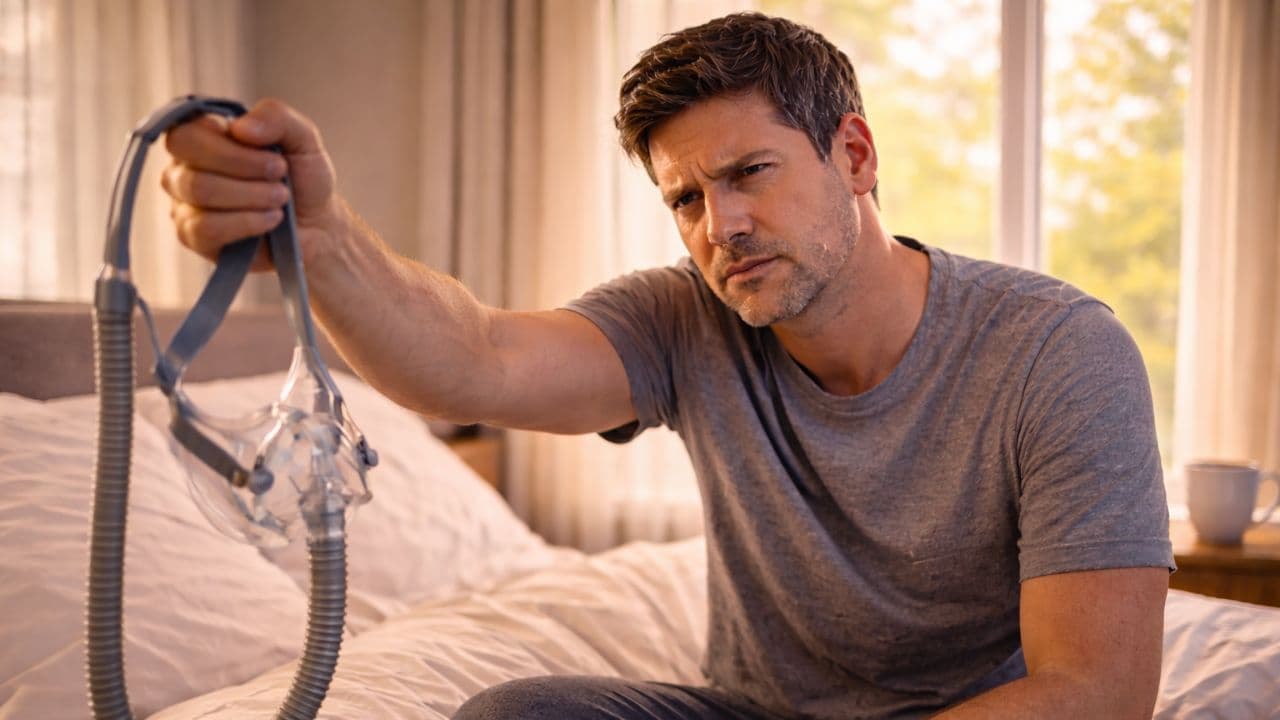
You know your sleep apnea is serious. You understand the health risks. You have been told you need treatment. And yet every night, putting on that CPAP mask feels like an act of self-punishment. The hose tangles in the sheets. The mask digs into your face. The noise keeps you or your partner awake. The whole routine has turned bedtime — the one part of the day that should feel restful — into something you dread.
If this describes you, you are in the majority, not the minority. The research is unambiguous: CPAP has a retention problem that no amount of patient education has solved in three decades of trying.
30-50% Abandon CPAP
Within the first 1-3 years, nearly half of all prescribed CPAP users stop using it entirely. This is not a statistic about lazy patients — it is data about a treatment that does not work for a significant portion of the people it is prescribed to.
46-83% Do Not Meet Compliance
Among those who continue using CPAP, fewer than half meet the minimum Medicare compliance threshold of 4 hours per night on 70% of nights. The gap between 'owning a CPAP' and 'being effectively treated' is enormous.
Untreated = Unprotected
A CPAP that sits on the nightstand does nothing. Untreated sleep apnea carries a 2x higher risk of heart attack, 2-4x higher risk of stroke, and 6x higher risk of drowsy driving accidents. The danger is real whether you quit CPAP or never start.
Why Patients Hate CPAP — It Is Not Just Discomfort
The word “discomfort” does not capture what CPAP-averse patients actually experience. The reasons people abandon CPAP span physical, psychological, relational, and lifestyle dimensions — and they compound over time rather than improving.
Physical Burden
Dry mouth, skin irritation, nasal congestion, aerophagia (bloating and gas), headband marks, and pressure sores. These are not first-week adjustment issues — they persist and often worsen over months of use.
Psychological Impact
Claustrophobia, anxiety, the feeling of being tethered to a machine, loss of spontaneity at bedtime. Some patients develop conditioned insomnia — their brain associates the bedroom with stress rather than rest. For others, the mask triggers PTSD-like responses.
Relationship Strain
The mask creates a physical barrier between partners. The noise (even modern quiet machines) disrupts a partner's sleep. Many patients report feeling embarrassed, unattractive, or self-conscious wearing the mask — eroding intimacy and connection.
Lifestyle Limitations
Traveling with CPAP means carrying equipment, finding outlets, managing distilled water, and dealing with TSA. Camping, staying at a partner's home, or falling asleep on the couch all become complicated events rather than natural moments.
If you are experiencing CPAP making you feel worse rather than better, that is not a phase you need to push through indefinitely. A treatment that a patient cannot sustain is not an effective treatment, regardless of how well it works in theory.
The Danger of Quitting Without a Plan
Here is the critical truth that makes this situation so frustrating: hating your CPAP does not change the fact that your sleep apnea needs treatment. The health consequences of untreated obstructive sleep apnea are not theoretical — they are well-documented, progressive, and potentially life-threatening.
Risks of Untreated Sleep Apnea:
Untreated OSA doubles all-cause mortality risk for severe cases. It independently increases the risk of hypertension, heart attack, stroke, atrial fibrillation, type 2 diabetes, and cognitive decline. These risks compound every year without treatment. Quitting CPAP is only safe if you replace it with an alternative treatment — not if you simply stop.
The worst possible outcome is not CPAP failure — it is abandoning treatment altogether. If you have decided CPAP is not for you, the next step is finding what works, not giving up. For a complete picture of what is at stake, see our article on the consequences of untreated sleep apnea.
Your Treatment Alternatives
CPAP is the most commonly prescribed treatment, but it is not the only one. The American Academy of Sleep Medicine recognizes multiple treatment approaches for obstructive sleep apnea, and the best treatment is always the one the patient will actually use consistently.
| Treatment | Best For | Adherence Rate | Insurance Coverage |
|---|---|---|---|
| Oral Appliance Therapy | Mild-to-moderate OSA, CPAP-intolerant patients | 77-90% at 1 year | Most PPO, Medicare, TRICARE |
| Inspire (Hypoglossal Nerve Stimulation) | Moderate-to-severe OSA, BMI under 35 | Surgically implanted | Most major carriers with prior auth |
| Positional Therapy | Position-dependent mild OSA | Variable | Limited coverage |
| Weight Loss / Lifestyle | Adjunct to primary treatment | Depends on support | N/A (behavioral) |
| Surgical Options (UPPP, MMA) | Anatomical obstruction, severe cases | One-time procedure | Varies by procedure and insurer |
For most CPAP-intolerant patients, oral appliance therapy is the most accessible and evidence-based alternative. It eliminates every mask-related problem — no hose, no noise, no claustrophobia, no aerophagia — while achieving comparable real-world health outcomes through dramatically higher nightly usage.
How Oral Appliance Therapy Works
An oral appliance is a custom-fitted device — similar in size to a sports mouthguard — that you wear during sleep. It gently advances your lower jaw forward by 6-10 millimeters, which pulls the tongue base and soft tissue away from the back of the throat and keeps your airway open.
Why CPAP-Intolerant Patients Prefer Oral Appliances:
The clinical data supports what patients report: oral appliances achieve 65-85% AHI reduction and 90%+ snoring elimination. While CPAP may produce a lower AHI number in lab settings, oral appliances achieve comparable cardiovascular, cognitive, and quality-of-life outcomes because patients actually wear them consistently. For a comprehensive overview, read our complete guide to oral appliance therapy or see how oral appliances compare to CPAP directly.
How to Transition from CPAP
Switching from CPAP to an alternative treatment is a medical decision, not just a personal preference — and it follows a defined process. Your documented CPAP intolerance is not a weakness; it is clinical evidence that strengthens the case for insurance approval of an alternative.
Document Your CPAP Experience
Gather your CPAP machine data showing usage patterns, leak rates, and residual AHI. Note which masks you have tried, what adjustments were made, and how long you gave each configuration. This documentation proves that CPAP was attempted and optimized — which is often required for insurance approval of alternatives.
Get a Referral or Self-Refer
Some dental sleep medicine practices accept direct patient referrals. Others work through your sleep physician. Either way, you do not need your sleep doctor's 'permission' to explore alternatives — but having their support makes the process smoother and strengthens insurance submissions.
Consultation and Evaluation
A dental sleep medicine specialist evaluates your jaw structure, tooth health, and bite to determine if you are a candidate for oral appliance therapy. This is typically a 30-45 minute appointment that includes digital scans of your teeth — no impressions or molds.
Insurance Pre-Authorization
Your provider submits a pre-authorization to your medical insurance (not dental). Your sleep study results plus CPAP compliance data plus documentation of CPAP intolerance form the clinical justification. Most approvals come back within 1-2 weeks.
Appliance Fabrication and Fitting
Your custom appliance is fabricated from the digital scans — typically 2-3 weeks. At the fitting appointment, your provider adjusts the mandibular advancement and teaches you how to insert, remove, and care for the device. Most patients adapt within 1-2 nights.
Follow-Up Sleep Test
After 4-6 weeks of use and adjustment, a follow-up home sleep test confirms the appliance is effectively reducing your AHI. This objective data verifies treatment success and satisfies insurance requirements for ongoing coverage.
The entire process — from consultation to wearing a fitted appliance — typically takes 3-6 weeks. That is 3-6 weeks from hating your treatment to having a solution you can actually live with.
Taking the First Step
The decision is not between CPAP and nothing. It is between CPAP and a treatment that actually fits your life. If you have given CPAP a genuine trial and it is clear that the therapy itself is preventing you from sleeping well, continuing to force it is not perseverance — it is leaving your sleep apnea functionally untreated.
Important: Do not stop CPAP before starting an alternative. Continue using CPAP — even imperfectly — while your oral appliance is being fabricated and fitted. Some treatment is better than no treatment during the transition period. Your dental sleep medicine provider will coordinate the handoff so there is no gap in coverage.
If you are still exhausted despite using CPAP, or if CPAP is actually making you feel worse, you have already spent enough time fighting a treatment that is not working for you. The compliance data shows you are not alone, and the alternatives available today mean you do not have to choose between a treatment you hate and no treatment at all.
Take our free 2-minute sleep assessment to see if oral appliance therapy may be right for you, or explore all CPAP alternatives for a program designed specifically for patients in your situation.
Frequently Asked Questions
What can I use instead of CPAP for sleep apnea?
The primary CPAP alternative is oral appliance therapy — a custom-fitted mouthpiece that advances the jaw to keep the airway open. It is FDA-cleared, AASM-recommended, and covered by most medical insurance plans. Other options include the Inspire hypoglossal nerve stimulator (for moderate-to-severe OSA with BMI under 35), positional therapy for position-dependent mild cases, and surgical interventions for anatomical obstruction.
Will insurance cover a CPAP alternative?
Yes. Most PPO medical insurance plans, Medicare Part B, and TRICARE cover oral appliance therapy as durable medical equipment. Your documented CPAP intolerance — including machine data showing low usage, multiple mask trials, and side effects — actually strengthens the case for insurance approval of alternatives.
How do I switch from CPAP to an oral appliance?
The process typically takes 3-6 weeks: consultation with a dental sleep medicine specialist, insurance pre-authorization using your CPAP intolerance documentation, digital scanning for a custom device, appliance fabrication, fitting appointment, and a follow-up sleep test to verify effectiveness. Continue using CPAP during the transition — do not leave a treatment gap.
Is oral appliance therapy as effective as CPAP?
Oral appliances achieve 65-85% AHI reduction compared to CPAP's near-complete AHI elimination. However, real-world health outcomes are comparable because oral appliance patients use their device 6.5-7 hours per night versus 4.5 for CPAP. A treatment worn consistently outperforms one that sits unused — and 90%+ of patients prefer oral appliances over CPAP in head-to-head studies.