Oral Appliance Therapy: The Complete Guide
Everything you need to know about oral appliance therapy for sleep apnea — how it works, who it helps, what to expect, and how it compares to CPAP.
Reviewed by Dr. Christopher Henninger, DMD
Last updated May 2025
Key Takeaways
- Oral appliance therapy is an FDA-cleared, AASM-recommended first-line treatment for mild-to-moderate sleep apnea — and for severe OSA when CPAP fails.
- Custom-fitted oral appliances achieve 65-85% AHI reduction and 90%+ snoring elimination, with the entire process taking 3-6 weeks.
- OAT is billed through medical insurance (not dental), and most PPO plans, Medicare Part B, and TRICARE provide coverage.
What Is Oral Appliance Therapy?
Oral appliance therapy (OAT) is an FDA-cleared treatment for obstructive sleep apnea that uses a custom-fitted oral device — worn in the mouth during sleep — to hold the lower jaw in a slightly forward position. This forward positioning opens the airway behind the tongue and soft palate, preventing the collapse that causes apnea events.
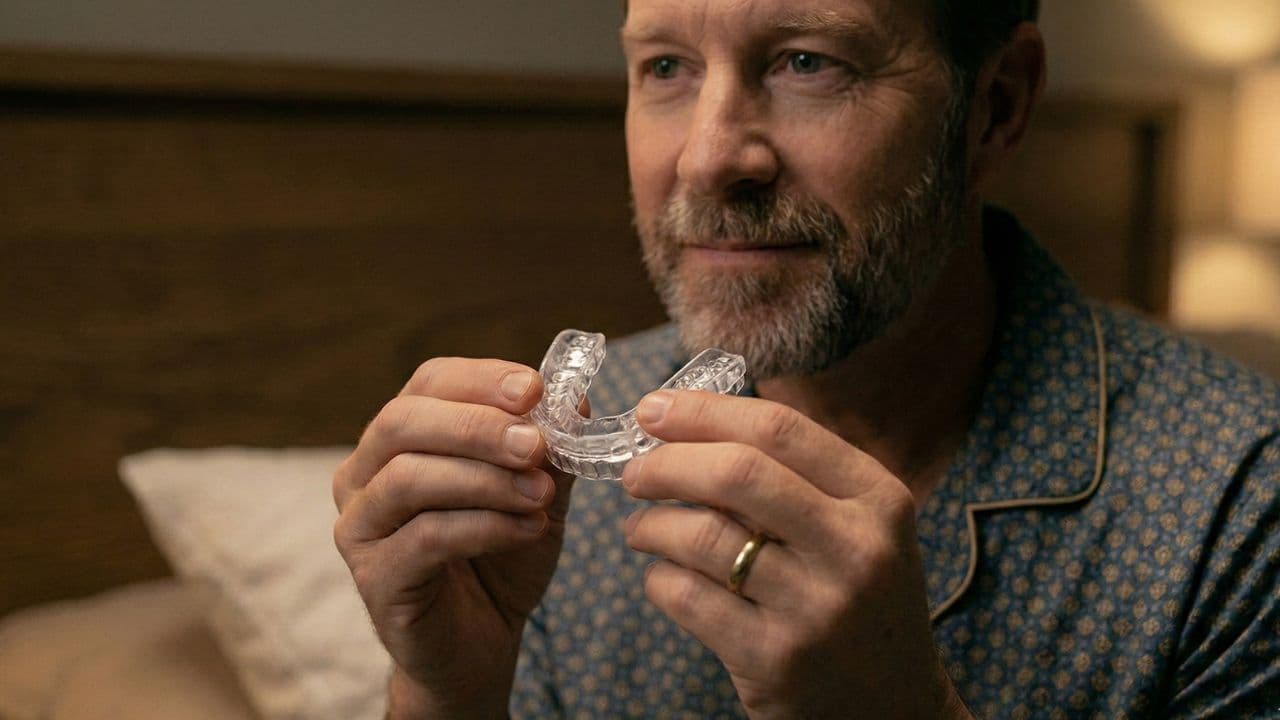
Think of it as a retainer for your breathing. The device is about the size of a sports mouthguard, made from medical-grade materials, and custom-fabricated from digital scans of your teeth. Unlike CPAP, there is no mask, no hose, no electricity, and no noise. You simply put it in your mouth before bed and take it out in the morning.
Key Facts
How It Works
When you fall asleep, the muscles in your throat relax. In people with sleep apnea, this relaxation allows the tongue and soft tissue to collapse backward, partially or fully blocking the airway. Each blockage — called an apnea event — stops your breathing until your brain triggers a micro-arousal to reopen the airway.
An oral appliance works by gently advancing the lower jaw (mandible) forward, typically by 6-10 millimeters. This forward position pulls the tongue base and surrounding soft tissue away from the back of the throat, creating more space for air to flow freely.
The device is adjustable — your dentist can fine-tune the amount of jaw advancement in small increments over several follow-up visits. This titration process ensures you get enough advancement to control your sleep apnea while keeping the device comfortable.
Who Is a Candidate?
Not everyone with sleep apnea is a candidate for oral appliance therapy. Your suitability depends on several factors including the severity of your OSA, your dental health, and your jaw anatomy.
Good Candidates
May Not Be Suitable
A board-certified dental sleep medicine specialist can evaluate your specific situation and determine whether OAT is appropriate for you. This evaluation typically includes a dental exam, review of your sleep study, and assessment of your jaw joint and range of motion.
Types of Oral Appliances
There are over 100 FDA-cleared oral appliances on the market, but they fall into two main categories:
Mandibular Advancement Devices (MADs)
The most common and well-studied type. MADs fit over the upper and lower teeth and use a mechanism to hold the lower jaw in a forward position. They are adjustable, allowing the dentist to fine-tune the amount of advancement. Examples include the Herbst, EMA, Panthera D-SAD, and ProSomnus devices.
Used for: OSA treatment and snoring elimination
Tongue Retaining Devices (TRDs)
Less commonly used, TRDs hold the tongue forward using suction rather than advancing the jaw. They may be suitable for patients who cannot use MADs due to dental limitations, such as those with few teeth or significant TMJ issues.
Used for: Patients who cannot wear a mandibular advancement device
Important: Over-the-counter "boil and bite" mouthpieces sold online are not the same as prescription oral appliances. They are not custom-fitted, cannot be properly adjusted, and are not covered by insurance. The AASM does not recommend OTC devices for sleep apnea treatment.
How Effective Is OAT?
Clinical evidence consistently shows that oral appliance therapy is effective for the majority of patients with mild-to-moderate OSA, and for many patients with severe OSA who cannot tolerate CPAP.
Reduction in AHI
Average decrease in apnea events per hour
Complete Resolution
Patients achieving AHI below 5 (normal range)
Snoring Elimination
Significant reduction or complete elimination
Importantly, because patients wear oral appliances for more hours per night and more nights per week than CPAP, the real-world health outcomes are often comparable. A treatment that works well and is used consistently delivers better results than a treatment that works perfectly but sits unused.
What the Treatment Process Looks Like
Getting started with oral appliance therapy is a straightforward process that typically takes 3-6 weeks from your first visit to having your custom device.
Consultation and Evaluation
Your dental sleep medicine specialist reviews your sleep study, examines your teeth and jaw, and determines whether you are a candidate. We also verify your insurance coverage at this stage.
Digital Impressions
Using a digital scanner (no gooey impression materials), we create a precise 3D model of your teeth. This takes about 10 minutes and is completely painless.
Custom Fabrication
Your appliance is fabricated in a dental laboratory using your digital scans. This takes 2-3 weeks depending on the device type selected.
Fitting and Calibration
You return to have your appliance fitted, adjusted for comfort, and calibrated to the initial advancement setting. We teach you how to insert, remove, and care for the device.
Titration and Follow-Up
Over the next 4-8 weeks, you return for adjustment visits where we gradually advance the device to the optimal position. This is determined by your symptom improvement and a follow-up sleep study.
Verification Sleep Study
A follow-up home sleep test confirms that the appliance is effectively treating your sleep apnea. This objective data verifies the treatment is working.
Potential Side Effects
Like any medical treatment, oral appliance therapy has potential side effects. Most are mild and temporary, occurring primarily during the adjustment period.
Jaw soreness
Common in the first 1-2 weeks. Similar to the feeling after wearing a retainer. Usually resolves as your jaw muscles adapt to the new position.
Excess salivation
Your mouth may produce extra saliva initially. This typically decreases within 1-2 weeks as your body adjusts to having the device in your mouth.
Temporary bite changes
Some patients notice a slight difference in their bite in the morning that resolves within 30-60 minutes. Morning jaw exercises can accelerate this.
Tooth tenderness
Mild pressure on the teeth is normal and usually resolves within the first few weeks. Your dentist monitors this closely and adjusts if needed.
Long-term bite changes are a concern that your dental sleep medicine specialist monitors at every follow-up visit. With proper monitoring and morning bite exercises, significant bite changes are uncommon and manageable.
Insurance Coverage
Oral appliance therapy is classified as durable medical equipment (DME) and is billed through your medical insurance — not dental insurance. This is an important distinction because medical insurance typically provides better coverage for medically necessary treatments.
We verify your insurance benefits before treatment begins so there are no surprises. Learn more about insurance coverage and costs or Medicare coverage specifically.
Frequently Asked Questions
How does an oral appliance treat sleep apnea?
An oral appliance gently advances the lower jaw forward by 6-10 millimeters during sleep. This pulls the tongue base and soft tissue away from the back of the throat, keeping the airway open and preventing the collapse that causes apnea events.
Who is a good candidate for oral appliance therapy?
Good candidates include patients with mild-to-moderate OSA (AHI 5-29), severe OSA patients who cannot tolerate CPAP, frequent travelers, people with claustrophobia, and anyone who wants a simpler, quieter treatment. You need adequate healthy teeth for the device to attach to.
Are over-the-counter mouthpieces the same as prescription oral appliances?
No. Over-the-counter boil-and-bite mouthpieces are not custom-fitted, cannot be properly adjusted, and are not covered by insurance. The AASM does not recommend OTC devices for sleep apnea treatment. Prescription oral appliances are custom-fabricated from digital scans by a trained dental sleep medicine specialist.
What side effects does oral appliance therapy have?
Most side effects are mild and temporary — jaw soreness for 1-2 weeks, excess salivation that resolves quickly, and temporary morning bite changes that clear within 30-60 minutes. Your dentist monitors for long-term bite changes at every follow-up visit.
Does medical insurance cover oral appliance therapy?
Yes. OAT is classified as durable medical equipment and billed through medical insurance. Most PPO plans, Medicare Part B (at 80%), and TRICARE cover it. Pre-authorization is usually required, and CPAP failure strengthens insurance approval.