Why Am I Still Tired Even with CPAP?
You wear your CPAP every night, your machine data looks good — but you are still exhausted. Here is why compliant CPAP use does not always mean restful sleep.
Reviewed by Dr. Andrew Gamache, DDS, D-IAOS
Last updated February 2026
Key Takeaways
- 30-50% of compliant CPAP users still report excessive daytime sleepiness — your experience is common and has identifiable causes.
- The most common culprit is insufficient usage hours: the 4-hour Medicare compliance minimum is far below the 6-7 hours needed to protect the restorative sleep stages that occur later in the night.
- If your CPAP data is genuinely good but you are still exhausted after 3 months, coexisting conditions (thyroid, PLMD, depression) or poor treatment fit may explain the gap — and alternatives like oral appliance therapy may achieve better real-world results through higher nightly usage.
The CPAP Promise vs. Your Reality
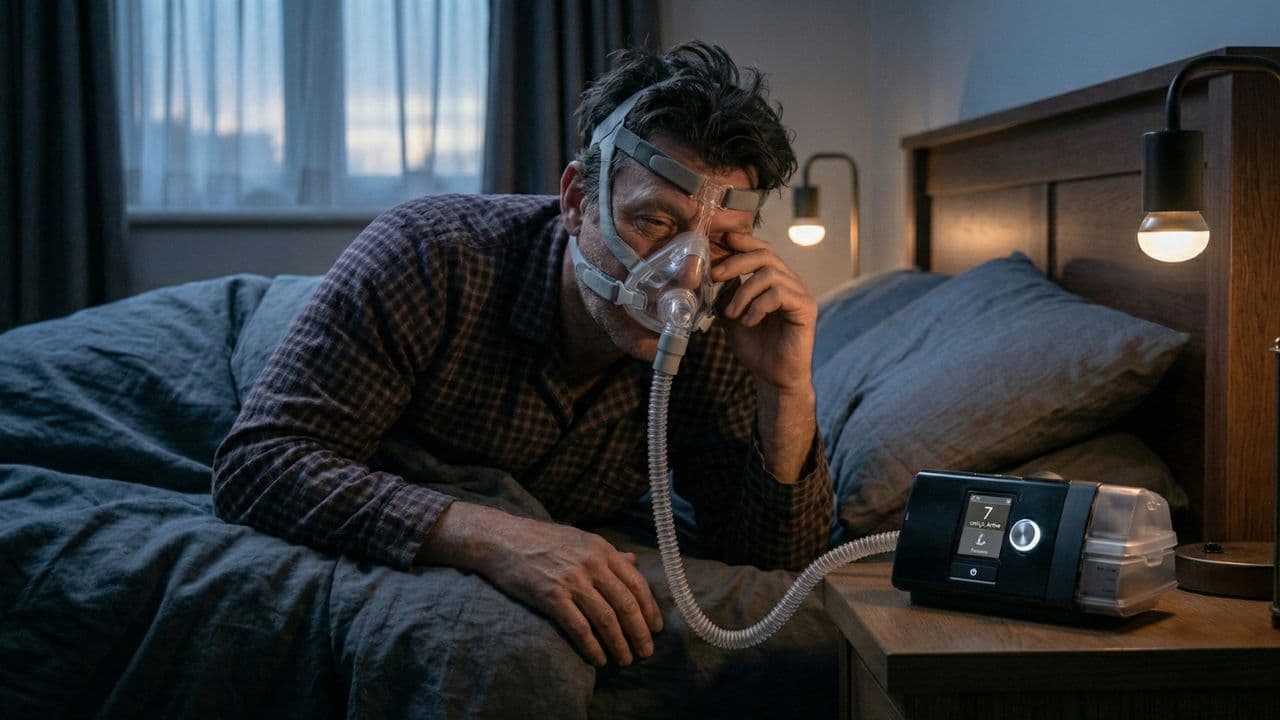
You are doing everything right. You wear your CPAP every night. You hit the compliance hours. Your machine data says your AHI is under 5. And yet every morning, you drag yourself out of bed feeling like you barely slept. The fatigue that was supposed to disappear is still there — maybe dimmed slightly, but stubbornly present.
This is more common than most patients realize. CPAP addresses obstructive apnea events, but it does not automatically restore the deep, restorative sleep your body has been missing. Several factors can explain why your machine says you are treated while your body says otherwise — and most of them have solutions.
Residual Sleepiness
Percentage of compliant CPAP users who report persistent excessive daytime sleepiness
Average Nightly Use
Typical CPAP usage — well below the 7+ hours needed for full sleep cycle coverage
Full Recovery Timeline
How long it can take for chronic sleep debt to fully resolve after starting effective treatment
The Usage Hours Problem
This is the single most overlooked explanation for persistent tiredness on CPAP: you are not wearing it long enough. Medicare defines compliance as 4 hours per night on 70% of nights — but sleep medicine research shows that 4 hours is not enough for most patients to feel genuinely rested.
Here is why: your most important REM sleep and deepest slow-wave sleep occur in the later sleep cycles — typically hours 5 through 8. If you put your CPAP on at midnight and take it off at 4 AM (or it comes off during sleep), you are protecting the first half of the night while leaving the most restorative sleep unprotected. Your AHI report may look compliant, but your brain is still being fragmented during the hours that matter most for feeling restored.
| CPAP Hours Per Night | AHI Control | Daytime Alertness | Health Benefits |
|---|---|---|---|
| Less than 4 hours | Partial | Minimal improvement | Limited cardiovascular protection |
| 4-5 hours | Good | Moderate improvement | Some blood pressure reduction |
| 5-6 hours | Good | Noticeable improvement | Meaningful cardiovascular benefit |
| 6-7+ hours | Excellent | Full restoration possible | Maximum health protection |
The research is clear: patients who use CPAP for 6-7 hours per night report dramatically better outcomes than those hitting the bare minimum 4-hour compliance mark. If your usage is under 6 hours, increasing wear time is the single most impactful change you can make.
Pressure Settings That Miss the Mark
Your CPAP pressure was set during your initial titration study — but your body is not static. Weight changes, aging, alcohol use, medication changes, and sleep position all affect the pressure you need. A setting that was perfect two years ago may be inadequate today, or a pressure that was set during an in-lab study may not match your real-world sleep conditions.
Check your data: If your CPAP machine reports a residual AHI above 5 events per hour, your pressure is likely too low. If you are experiencing frequent central apneas, aerophagia, or mask removal during sleep, your pressure may be too high. Either scenario leaves you feeling unrefreshed. Ask your provider to review your 90-day data download — not just the single-night numbers.
Auto-titrating CPAP (APAP) machines adjust pressure automatically, but they are not infallible. APAP relies on detecting flow limitation and apnea events in real time, and some events — especially upper airway resistance events (RERAs) — can slip under the detection threshold. You can still have significant sleep fragmentation from respiratory events that your machine does not count. If you are using APAP and still tired, a manual titration or a comprehensive data review may reveal the gap.
For a deeper look at how pressure problems create a cascade of symptoms, see our article on why CPAP can make you feel worse.
Mask Leaks and Mouth Breathing
Mask leaks are the silent saboteur of CPAP therapy. A mask that fits well when you put it on may shift as you move through sleep cycles, opening gaps that reduce effective pressure delivery. Your machine logs may show 7 hours of use, but if 3 of those hours involved significant leak, you were getting sub-therapeutic treatment for nearly half the night.
Positional Leaks
Side sleeping compresses the mask against the pillow, breaking the seal. Back sleeping often causes mouth opening, which creates leak in nasal masks. Your leak pattern may correlate with body position changes throughout the night.
Mouth Breathing with Nasal Masks
If you breathe through your mouth during sleep — whether from nasal congestion, habit, or jaw relaxation — a nasal mask or nasal pillows cannot deliver effective pressure. The air goes in your nose and straight out your mouth, bypassing the airway entirely.
Mask Degradation
Silicone cushions lose elasticity over time. A mask that sealed perfectly 6 months ago may have micro-cracks and compression marks that prevent consistent contact. Most manufacturers recommend replacing cushions every 1-3 months.
The fix depends on the cause. A CPAP pillow with cutouts can reduce positional leaks for side sleepers. A chin strap can address mouth breathing with nasal masks. And if mouth breathing persists, switching to a full-face mask may be necessary — though full-face masks come with their own set of challenges including higher leak potential and claustrophobia risk.
When Sleep Apnea Is Not the Only Problem
CPAP treats obstructive sleep apnea. But persistent fatigue despite good CPAP data can signal a coexisting condition that CPAP does not address. These conditions can exist alongside OSA, and treating one without addressing the other leaves you feeling unrefreshed.
Conditions That Cause Fatigue Alongside OSA:
If your CPAP data is genuinely good — AHI below 5, leak rate low, usage over 6 hours — and you still feel exhausted, ask your sleep physician about evaluating for these coexisting conditions. An in-lab polysomnography (sleep study) can detect limb movements, sleep stage abnormalities, and other issues that a home sleep test and CPAP data cannot reveal.
The Sleep Debt Recovery Timeline
Even when CPAP is working perfectly, expecting immediate transformation is unrealistic. If you have had untreated sleep apnea for years — and the average patient goes 5-10 years before diagnosis — you are carrying a massive sleep debt. Your brain and body have been operating in a state of chronic oxygen deprivation and sleep fragmentation, and recovery is not instant.
Week 1-2: Adjustment Period
This is often the hardest phase. You may feel worse before you feel better as your body adjusts to the mask, the pressure, and the different sleep architecture. Some patients experience REM rebound — an increase in vivid dreams as the brain catches up on missed REM sleep.
Week 2-4: Early Improvements
Morning headaches often resolve first. Snoring stops. Bed partners notice the difference before you do. You may notice slightly better focus and fewer afternoon energy crashes, but fatigue can still be significant.
Month 1-3: Noticeable Change
Most patients who will respond well to CPAP notice meaningful daytime improvement in this window. Energy increases, mood stabilizes, and the feeling of dragging through the day begins to lift. If you notice zero improvement by month 3 with optimized settings, something else may be at play.
Month 3-12: Full Recovery
Deep recovery of cognitive function, metabolic regulation, and cardiovascular health continues for months after starting effective treatment. Patients with severe, long-standing sleep apnea may take 6-12 months to feel the full benefit.
The key question is not whether you feel perfect — it is whether the trajectory is improving. If each month is slightly better than the last, you are on the recovery curve. If month 3 feels identical to week 1 despite good machine data, that is a signal to investigate further.
What to Do If You Are Still Tired
Persistent fatigue on CPAP is not something you should accept as your new normal. It is a clinical signal that something needs attention — whether that is optimizing your current therapy, investigating coexisting conditions, or considering a treatment approach that may work better for your body.
Optimize Your Current CPAP:
Consider an Alternative Approach:
Research consistently shows that CPAP compliance rates remain challenging — 30-50% of patients abandon therapy within the first year. If you are using CPAP but not feeling better, the issue may not be your willpower but the treatment fit. Oral appliance therapy achieves comparable real-world outcomes because patients wear it more consistently — 6.5-7 hours per night compared to 4.5 for CPAP.
If you are frustrated with CPAP but know you need treatment, explore your alternatives before you give up entirely. Learn how oral appliance therapy works as the most common alternative, or compare oral appliances directly to CPAP to understand the tradeoffs.
The worst outcome is not failing CPAP — it is leaving sleep apnea untreated. Whatever treatment path you choose, getting effective therapy matters far more than which device delivers it. Take our free 2-minute sleep assessment to explore your next step.
Frequently Asked Questions
Why am I still tired after using CPAP all night?
The most common causes are insufficient usage hours (wearing it less than 6-7 hours), suboptimal pressure settings (residual AHI above 5 or treatment-emergent central apneas), significant mask leaks undermining therapy, a coexisting sleep disorder that CPAP does not address, or incomplete recovery from years of accumulated sleep debt. Checking your machine data is the critical first diagnostic step.
How many hours of CPAP use do I actually need?
While Medicare defines compliance at 4 hours per night, research shows that meaningful improvement in daytime alertness requires 6-7 hours of use. Your most restorative REM and deep sleep stages occur in the later sleep cycles — if you remove CPAP after 4-5 hours, you are leaving those critical stages unprotected.
How long does it take for CPAP to make you feel rested?
Most patients notice meaningful improvement within 1-3 months of optimized use. Full cognitive and metabolic recovery can take 6-12 months, especially for patients with severe, long-standing sleep apnea. If you notice zero improvement after 3 months of optimized therapy (6+ hours, low leak, AHI under 5), further investigation is warranted.
Should I try something other than CPAP if I am still tired?
If you have optimized your CPAP settings, increased usage hours, ruled out coexisting conditions, and still feel no better after a genuine 3-month trial, exploring alternatives is reasonable. Oral appliance therapy achieves comparable health outcomes with higher nightly usage (6.5-7 hours vs 4.5 for CPAP) because patients find it more comfortable and sustainable.