CPAP Alternatives Your Doctor Might Not Mention
Your doctor prescribed CPAP — but that is not the only evidence-based treatment for sleep apnea. Here are the alternatives the research supports and how to access them.
Reviewed by Dr. Andrew Gamache, DDS, D-IAOS
Last updated February 2026
Key Takeaways
- Most sleep physicians are trained in a CPAP-first protocol — the AASM also recommends oral appliance therapy for mild-to-moderate OSA and CPAP-intolerant patients, but this option is frequently not discussed.
- Oral appliance therapy achieves 77-90% adherence at one year (vs. 50-60% for CPAP) and comparable real-world health outcomes, making it the most accessible evidence-based CPAP alternative for most patients.
- You do not need your doctor's permission to explore alternatives — a dental sleep medicine specialist can evaluate your candidacy, and your documented CPAP intolerance strengthens insurance approval.
Why Your Doctor Only Mentions CPAP
If your doctor diagnosed your sleep apnea and the only treatment discussed was CPAP, you are not getting bad medical care — you are getting incomplete information. Most primary care physicians and sleep medicine specialists are trained in a CPAP-first protocol, and many have limited exposure to the full range of evidence-based alternatives. This is not a conspiracy. It is a training and referral gap that has persisted for decades.
Sleep Medicine Training Is CPAP-Centric
Sleep medicine fellowships and residency programs focus heavily on polysomnography interpretation and CPAP titration. Dental sleep medicine — the specialty that manages oral appliances — is a separate field with its own training pathways, credentialing, and board certifications.
Referral Networks Are Siloed
Most sleep physicians refer within their own system: sleep lab to DME supplier to follow-up. Dental sleep medicine specialists operate outside this referral loop, so many sleep doctors simply do not have a trusted oral appliance provider to send patients to.
Limited Appointment Time
A typical sleep medicine follow-up is 10-15 minutes. Explaining one treatment option is efficient. Presenting multiple alternatives, comparing efficacy data, and discussing candidacy for each requires time most appointment slots do not allow.
CPAP Is the Default Standard of Care
CPAP has been the first-line recommendation since the 1980s. Guidelines from the AASM do recommend oral appliance therapy for mild-to-moderate OSA and CPAP-intolerant patients — but many clinicians default to what they know best, which is CPAP.
Understanding this gap is important because it reframes the situation: your doctor is not withholding options from you. They may simply not be aware of the current evidence, or not have the referral infrastructure to offer alternatives. The responsibility for finding the full picture often falls on the patient — and that is what this article provides.
The Full Landscape of CPAP Alternatives
The American Academy of Sleep Medicine recognizes multiple treatment modalities for obstructive sleep apnea. Each has specific candidacy criteria, evidence supporting its use, and practical considerations. Here is the data on each.
77-90%
OAT Adherence at 1 Year
Oral appliance therapy achieves dramatically higher long-term compliance than CPAP, primarily because patients find it comfortable enough to use consistently.
65-85%
AHI Reduction with OAT
Custom oral appliances reduce apnea events by 65-85% and eliminate snoring in over 90% of patients, with comparable real-world health outcomes to CPAP.
BMI < 35
Inspire Candidacy Threshold
The Inspire hypoglossal nerve stimulator is FDA-approved for moderate-to-severe OSA in patients with a BMI under 35 who cannot tolerate CPAP.
50-60%
CPAP Retention at 1 Year
By comparison, CPAP retains only about half its users after the first year — and those who continue often use it fewer hours than needed for full protection.
The critical principle across all alternatives: the best treatment for sleep apnea is the one you will actually use. A treatment with slightly lower theoretical efficacy that a patient uses every night outperforms a theoretically superior treatment that sits unused. The CPAP compliance data makes this case unambiguously.
Oral Appliance Therapy
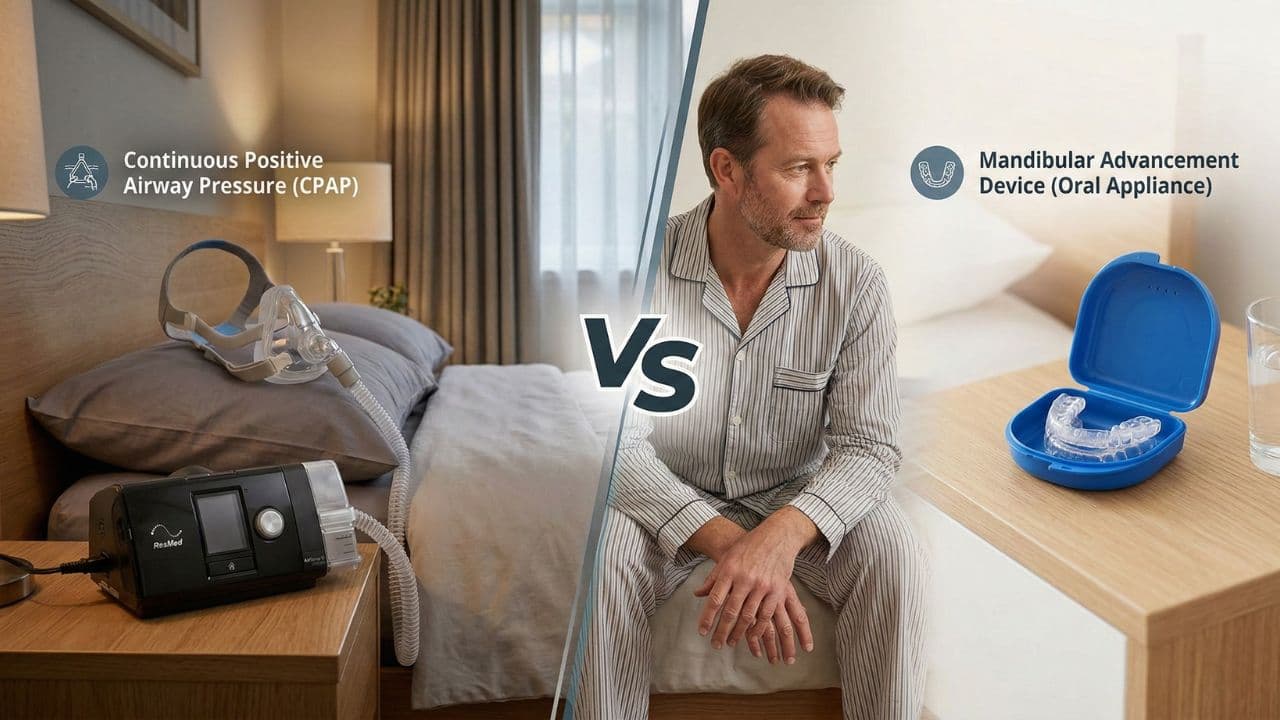
For most CPAP-intolerant patients, oral appliance therapy is the most accessible, evidence-based alternative. It is an FDA-cleared, custom-fitted mouthpiece that advances the lower jaw forward during sleep, keeping the airway open without any mask, hose, or machine. The AASM recommends it as a first-line treatment for mild-to-moderate OSA and as the primary alternative for severe OSA when CPAP has failed.
| Factor | CPAP | Oral Appliance |
|---|---|---|
| AHI Reduction | Near-complete (lab setting) | 65-85% reduction |
| Nightly Usage | 4.5 hours average | 6.5-7 hours average |
| 1-Year Adherence | 50-60% | 77-90% |
| Patient Preference | ~10% in head-to-head | 90%+ in head-to-head |
| Travel Friendly | Requires power, TSA screening | Fits in a retainer case |
| Noise Level | Audible motor + air leak sounds | Silent |
| Common Side Effects | Dry mouth, skin irritation, aerophagia | Temporary jaw soreness, excess saliva |
The data tells a clear story: while CPAP produces lower AHI numbers in controlled settings, oral appliances deliver comparable real-world cardiovascular, cognitive, and quality-of-life outcomes because patients use them for more hours and more nights. For a deep dive, read our complete guide to oral appliance therapy or see the full OAT vs. CPAP comparison.
Inspire Hypoglossal Nerve Stimulation
Inspire is a surgically implanted device that stimulates the hypoglossal nerve to keep the airway open during sleep. It is FDA-approved for moderate-to-severe obstructive sleep apnea in patients who cannot tolerate CPAP. The device is activated by a small remote control at bedtime and works automatically through the night.
Inspire Candidacy Requirements:
Inspire shows strong efficacy — studies report approximately 79% reduction in AHI and significant improvement in daytime sleepiness. However, the candidacy criteria are narrow, the procedure is surgical, and the cost is substantial even with insurance. For most CPAP-intolerant patients, oral appliance therapy is the more accessible first step. For a detailed comparison, see our oral appliance vs. Inspire comparison.
Positional Therapy and Lifestyle Approaches
For a subset of patients — particularly those with mild, position-dependent sleep apnea — positional therapy and lifestyle modifications can play a meaningful role. However, it is critical to understand their limitations.
Positional therapy involves devices or techniques that keep you off your back during sleep, since supine sleeping worsens airway collapse. This approach works best when sleep apnea events occur primarily or exclusively in the supine position and the overall severity is mild.
Weight loss can reduce sleep apnea severity — a 10% weight reduction is associated with approximately 26% improvement in AHI. However, as we explain in our article on sleep apnea and weight gain, losing weight while sleep apnea is untreated is extremely difficult because the condition itself disrupts the hormones that regulate appetite, metabolism, and energy.
Important: Positional therapy and lifestyle changes are not standalone treatments for moderate-to-severe sleep apnea. They work best as supplements to a primary treatment like oral appliance therapy or CPAP. If your AHI is above 15, relying on positional therapy or weight loss alone leaves significant apnea events untreated.
How to Talk to Your Doctor About Alternatives
Asking your doctor about CPAP alternatives does not have to be adversarial. The goal is a productive conversation that leads to the right treatment — not a confrontation. Here is a practical approach.
Lead with Your Experience, Not Your Research
Start with what you have experienced: 'I have been struggling with CPAP for [X months]. The specific problems are [list them]. I want to make sure I am still getting effective treatment.' This frames the conversation around your clinical experience, not internet articles.
Ask Specifically About Oral Appliance Therapy
Say: 'I have read that the AASM recommends oral appliance therapy for patients who cannot tolerate CPAP. Am I a candidate for that?' This references the clinical guideline directly and asks a specific yes-or-no question.
Request a Referral to a Dental Sleep Medicine Specialist
If your doctor is not familiar with oral appliances, ask for a referral: 'Can you refer me to a dental sleep medicine specialist for a consultation?' You can also self-refer — many dental sleep medicine practices accept patients directly.
Bring Your CPAP Data
Download or print your CPAP compliance data showing usage hours, leak rates, and residual AHI. This objective documentation supports the clinical case for exploring alternatives and strengthens insurance pre-authorization.
Document the Conversation
Keep notes on what alternatives were discussed, what your doctor's reasoning was, and any referrals provided. If alternatives were not discussed, note that too — this documentation can support future insurance appeals if needed.
If your doctor dismisses alternatives without discussing the evidence, or if you have already given up on CPAP entirely, seeking a consultation with a dental sleep medicine specialist directly is a reasonable next step. You do not need permission to explore your options.
Finding the Right Specialist
Not all dentists who offer oral appliances have the same level of training and experience. Dental sleep medicine is a specialized field, and the quality of your outcome depends heavily on the expertise of your provider. Here is what to look for — and what to avoid.
Look For
- Board certification or diplomate status (D-ABDSM or D-IAOS)
- Dedicated dental sleep medicine practice, not a side offering
- Direct collaboration with sleep physicians for diagnosis and follow-up
- Insurance billing through medical insurance (not dental)
- Follow-up sleep testing to verify treatment effectiveness
- Experience with multiple appliance types, not just one brand
Avoid
- General dentists offering OAT without sleep medicine training
- Providers who skip the sleep study or diagnosis step
- Practices that bill through dental insurance instead of medical
- Over-the-counter or boil-and-bite mouthpiece recommendations
- Providers who do not perform follow-up sleep testing
- Anyone who guarantees results before evaluating your case
Before making any changes to your treatment, it is important to understand the safety considerations around stopping CPAP. The goal is never to abandon treatment — it is to find the right treatment for your body, your lifestyle, and your long-term health.
Take our free 2-minute sleep assessment to see if you may be a candidate for oral appliance therapy, or explore all available CPAP alternatives to understand your options.
Frequently Asked Questions
What CPAP alternatives does the AASM recommend?
The American Academy of Sleep Medicine recommends oral appliance therapy as a first-line treatment for mild-to-moderate obstructive sleep apnea and as the primary alternative for patients with severe OSA who cannot tolerate CPAP. The Inspire hypoglossal nerve stimulator is FDA-approved for moderate-to-severe OSA in patients with BMI under 35. Positional therapy and lifestyle modifications are recommended as adjuncts, not standalone treatments, for most patients.
Why did my doctor only prescribe CPAP?
Most sleep medicine training programs focus heavily on CPAP titration and management. Dental sleep medicine — the specialty that manages oral appliances — operates in a separate referral ecosystem. This is a training and referral gap, not a quality-of-care problem. You can ask your doctor specifically about oral appliance therapy or self-refer to a dental sleep medicine specialist.
How do I find a dental sleep medicine specialist?
Look for providers with board certification in dental sleep medicine (D-ABDSM or D-IAOS), a dedicated sleep medicine practice rather than a side offering, and direct collaboration with sleep physicians. The provider should bill through medical insurance, use multiple appliance types, and perform follow-up sleep testing to verify effectiveness.
Can I switch from CPAP to an oral appliance?
Yes. The transition process typically takes 3-6 weeks: consultation, insurance pre-authorization using your CPAP intolerance documentation, digital scanning, appliance fabrication, fitting, and a follow-up sleep test. Your documented CPAP struggles strengthen the insurance case for oral appliance therapy. Continue using CPAP during the transition to avoid a treatment gap.