Why Am I So Tired Even Though I Slept 8 Hours?
Sleeping 8 hours but still exhausted? When sleep quantity looks fine but quality is destroyed, sleep apnea is the most common hidden cause — and most people who have it don't know.
Reviewed by Dr. Andrew Gamache, DDS, D-IAOS
Last updated February 2026
Key Takeaways
- An estimated 936 million adults worldwide have obstructive sleep apnea, and up to 80% of moderate-to-severe cases go undiagnosed — many in people who believe they are getting enough sleep.
- Sleep apnea causes your brain to wake up dozens or hundreds of times per night, fragmenting your sleep architecture so severely that 8 hours in bed may deliver only 3-4 hours of restorative sleep.
- A home sleep test can diagnose sleep apnea in 1-2 nights from your own bed, and effective treatment options exist beyond CPAP — including custom oral appliances with 90%+ patient satisfaction.
Sleep Quantity vs. Sleep Quality
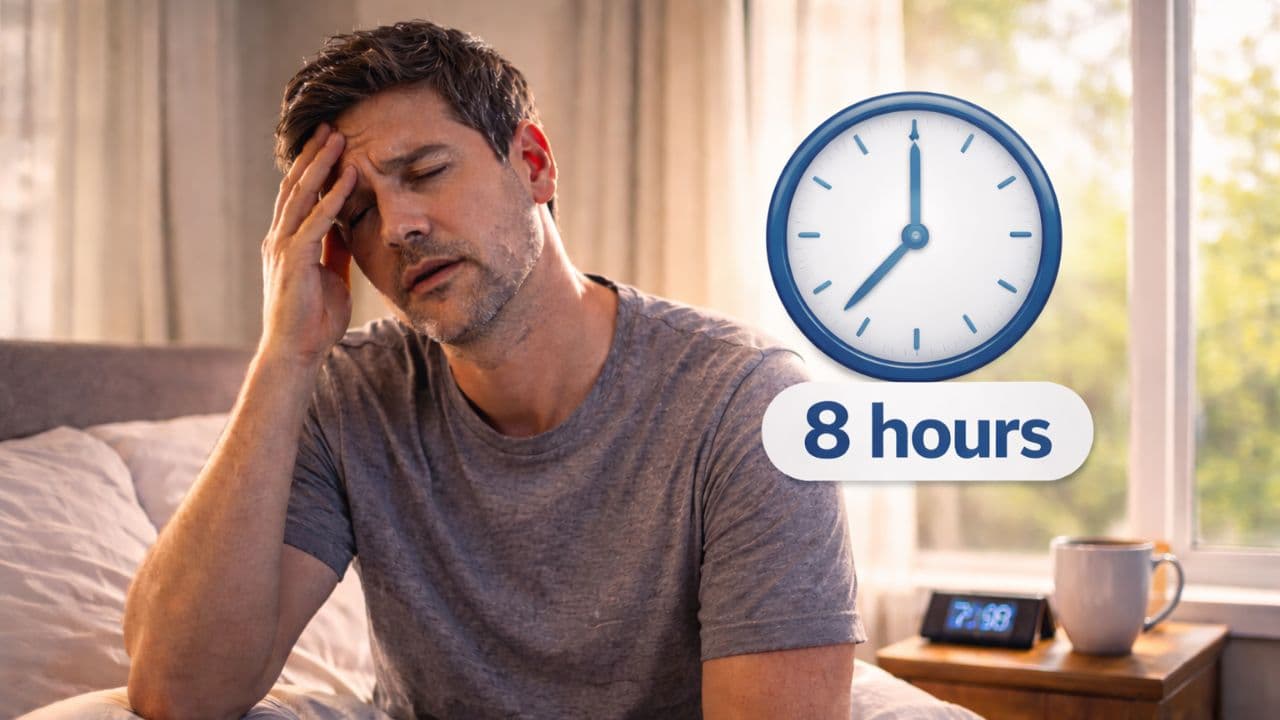
You set an alarm for 8 hours. You stayed in bed the entire time. And yet you woke up feeling like you barely slept at all. The frustration is real — and it is more common than you might think. If this cycle has been repeating for weeks or months, you are not lazy, and you are not imagining it. Something may be interrupting your sleep from the inside.
The distinction that most people miss is the difference between sleep quantity and sleep quality. You can spend 8 hours in bed and still get only a fraction of the restorative sleep your body needs. When something disrupts your sleep architecture — the natural progression through light sleep, deep sleep, and REM — your brain never completes the repair cycles that make you feel rested.
Healthy Sleep (8 Hours)
Fragmented Sleep (8 Hours in Bed)
The most common cause of this pattern — sleeping long enough but never feeling rested — is obstructive sleep apnea. And the most important thing to understand is that most people who have it do not know.
What Sleep Apnea Does to Your Sleep
Obstructive sleep apnea occurs when the soft tissue in your throat relaxes during sleep and collapses inward, partially or completely blocking your airway. When airflow stops, your blood oxygen drops. Your brain detects the danger and jolts you awake just enough to restore muscle tone and reopen the airway. You gasp, take a breath, fall back asleep — and the cycle repeats.
These are called micro-arousals, and they are so brief that you usually have no memory of them. But they are devastating to sleep quality. Each arousal pulls you out of whatever sleep stage you were in, forcing your brain to start the cycle over from light sleep.
936M
adults worldwide have obstructive sleep apnea
80%
of moderate-to-severe cases are undiagnosed
30+
breathing interruptions per hour in severe cases
In moderate sleep apnea, your breathing stops 15 to 29 times per hour. In severe cases, it happens 30 or more times per hour — meaning your brain is being yanked out of restorative sleep every one to two minutes. Over the course of a night, that can add up to hundreds of disruptions. You spent 8 hours in bed, but your brain may have received 3 to 4 hours of actual restorative sleep.
Symptoms You Might Not Connect to Sleep
Daytime exhaustion is the symptom that drives most people to search for answers. But sleep apnea affects far more than your energy level. Because it disrupts oxygen delivery and hormonal regulation throughout the night, the downstream effects touch nearly every system in your body. Many people have several of these symptoms without realizing they share a single root cause.
Common Sleep Apnea Symptoms Beyond Fatigue
If you recognize three or more of these symptoms alongside persistent tiredness, sleep apnea moves from possible to probable. The more symptoms you have, the stronger the case for getting tested. Many patients describe a moment of recognition — realizing that the headaches, the brain fog, the weight gain, and the exhaustion are not separate problems but one problem with one solution.
Who Is at Risk?
Sleep apnea does not discriminate as much as people think. While certain factors increase risk significantly, the condition affects people across every age, weight, and demographic. The stereotype of an overweight older man is outdated — and it causes millions of women, younger adults, and fit individuals to go undiagnosed.
Age over 40
Muscle tone in the throat decreases with age, making airway collapse more likely during sleep. Risk increases further after age 50.
Excess weight
Fat deposits around the upper airway narrow the breathing passage. A 10% weight gain increases apnea events by 32%. However, 20-30% of sleep apnea patients are not overweight.
Neck circumference over 17 inches (men) or 16 inches (women)
A thicker neck often indicates more soft tissue that can compress the airway during sleep.
Family history
Jaw structure, tongue size, and airway shape are inherited. If a parent or sibling has sleep apnea, your risk is 2-4 times higher.
Nasal obstruction or anatomical factors
A deviated septum, enlarged tonsils, a recessed jaw, or a naturally narrow airway all increase risk regardless of weight.
Women are particularly underdiagnosed. Sleep apnea in women often presents differently — with insomnia, fatigue, depression, and anxiety rather than loud snoring — leading to misdiagnosis as depression or chronic fatigue syndrome. If you are a woman experiencing persistent tiredness that does not respond to sleep hygiene improvements, sleep apnea deserves consideration. You can learn more about how snoring relates to sleep apnea and why not all cases involve loud snoring.
Warning Signs You Should Not Ignore
Some signs point strongly enough toward sleep apnea that they warrant prompt evaluation. If any of the following describe your experience, do not wait and see — these are signals that your body is under nightly stress.
Get Tested If You Experience Any of These
Witnessed breathing pauses are the single strongest predictor of obstructive sleep apnea. If someone who sleeps near you has told you that you stop breathing, snore loudly, or gasp during sleep, that observation alone is enough to justify a sleep test. Untreated sleep apnea is associated with a cascade of serious health consequences that worsen over time — including a measurable impact on life expectancy.
How to Get Tested
The good news is that sleep apnea diagnosis has become faster and more convenient than ever. You do not need to spend a night in a hospital sleep lab. Most patients can be diagnosed with a home sleep test — a small, portable device you wear in your own bed for one or two nights.
Take a sleep assessment
A brief screening questionnaire helps determine your risk level and whether a sleep test is appropriate. This can often be done online in under 2 minutes.
Complete a home sleep test
A compact device is shipped to your home or picked up from your provider. You wear it for 1-2 nights while sleeping normally. It measures airflow, oxygen levels, heart rate, and breathing effort.
Review results with a sleep specialist
Your sleep data produces an AHI (apnea-hypopnea index) score. An AHI of 5 or above confirms sleep apnea. Your provider explains severity and discusses treatment options.
Start treatment
Treatment options include CPAP, oral appliance therapy, or a combination approach — depending on your severity, anatomy, and preferences. Most patients feel a difference within the first week.
For a detailed walkthrough of the testing process, see our guide on what to expect from a home sleep test. Home sleep tests are covered by most insurance plans, Medicare, and TRICARE.
Taking the First Step
If you have been telling yourself that your tiredness is just stress, aging, or a busy schedule — but nothing you try makes it better — it is worth finding out whether something treatable is stealing your sleep from the inside. Sleep apnea is one of the most underdiagnosed conditions in medicine, but it is also one of the most treatable.
Treatment does not have to mean a CPAP machine. For many patients with mild-to-moderate sleep apnea, a custom oral appliance — a small, silent mouthpiece worn during sleep — is the preferred treatment. It requires no mask, no hose, no electricity, and fits in your pocket when you travel.
A note on self-diagnosis: While symptom checklists can indicate risk, the only way to confirm sleep apnea is through a sleep study that measures your breathing during sleep. Do not assume you are fine because you do not snore loudly — and do not assume you have sleep apnea based on tiredness alone. A sleep test gives you a definitive answer.
The difference between waking up exhausted and waking up restored could be a diagnosis away. Take our free 2-minute sleep assessment to understand your risk — no obligation, instant results.
Frequently Asked Questions
Why am I exhausted after sleeping 8 hours?
The most likely cause is disrupted sleep quality, not insufficient quantity. Obstructive sleep apnea causes your airway to collapse repeatedly during sleep, triggering micro-arousals that pull you out of deep sleep and REM stages. You have no memory of these awakenings, but they prevent your brain from completing the restorative sleep cycles that make you feel rested.
Can you have sleep apnea and not know it?
Yes. Up to 80% of moderate-to-severe sleep apnea cases are undiagnosed. Because the breathing interruptions and micro-arousals happen during sleep, most people have no awareness of them. The primary clues are daytime symptoms — persistent fatigue, morning headaches, brain fog, and mood changes — rather than anything you notice during the night.
What does sleep apnea tiredness feel like?
Unlike normal tiredness that improves with more sleep, sleep apnea fatigue is unrelenting. Patients describe it as feeling like they never actually slept, needing to nap despite a full night in bed, struggling to focus or remember things, and feeling physically drained even without exertion. It does not improve with earlier bedtimes or sleeping in on weekends.
How do I know if I should get tested for sleep apnea?
You should consider testing if tiredness persists despite sleeping 7-9 hours, especially if combined with loud snoring, witnessed breathing pauses, morning headaches, difficulty concentrating, frequent nighttime urination, or unexplained weight gain. A free 2-minute sleep assessment can help determine your risk level before committing to a full sleep test.