Home Sleep Test: What to Expect
A home sleep test is the fastest, most convenient way to find out if you have sleep apnea. Here is exactly what happens — from ordering to results.
Reviewed by Thomas D'Acquisto, Sleep Director, 39 Years in Sleep Medicine
Last updated June 2025
Key Takeaways
- A home sleep test is a portable device you wear in your own bed for 1-2 nights — no sleep lab visit required.
- Home sleep tests are 95%+ accurate for detecting moderate-to-severe sleep apnea, accepted by Medicare and all major insurance carriers.
- Results are typically available within 3-5 business days, and an AHI score of 5 or above means you have sleep apnea and are eligible for insurance-covered treatment.
What Is a Home Sleep Test?
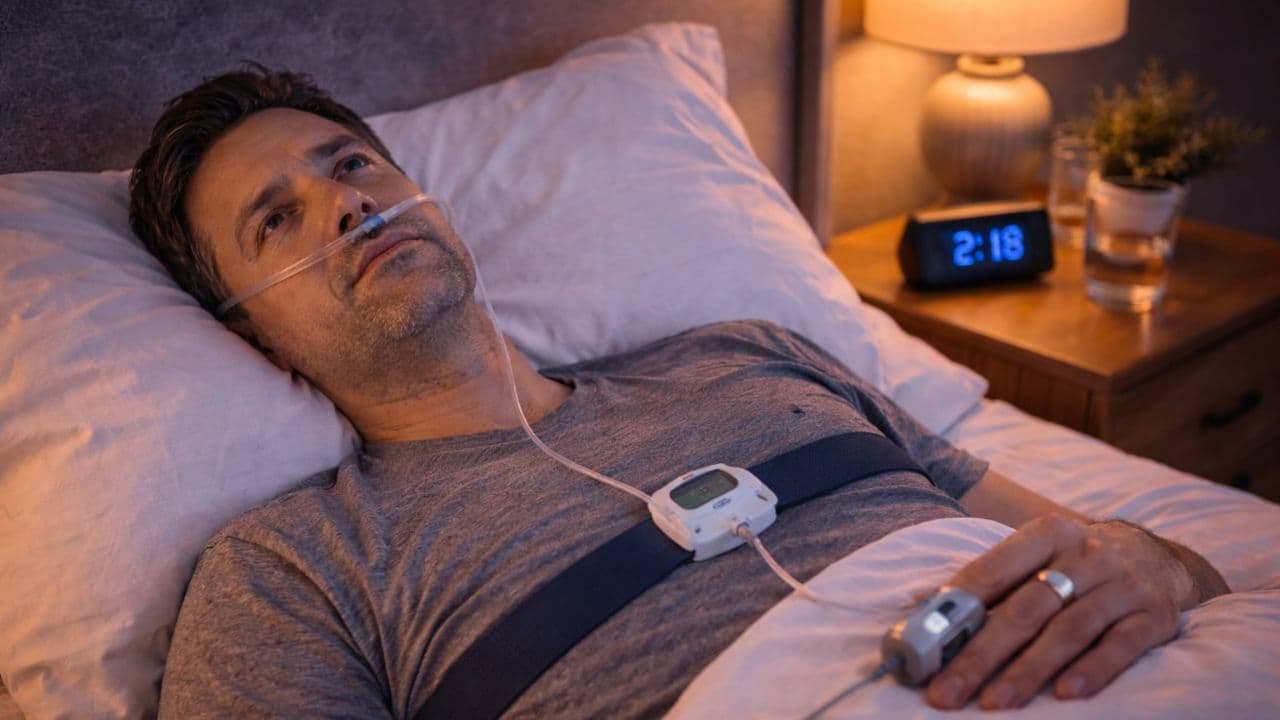
A home sleep test (HST) — also called a home sleep apnea test (HSAT) — is a simplified sleep study that you perform in your own bed. Instead of spending a night in a sleep lab, you wear a small portable device that records your breathing patterns, oxygen levels, heart rate, and body position while you sleep at home.
Home sleep tests have become the standard first-line diagnostic tool for obstructive sleep apnea. They are approved by Medicare, accepted by all major insurance carriers, and are significantly more comfortable and convenient than traditional in-lab studies. Most patients prefer them because they can sleep in their own bed, follow their normal routine, and avoid the unfamiliar environment of a sleep lab.
Nights
Most tests require just one or two nights of recording
Accuracy
For detecting moderate-to-severe sleep apnea
Days for Results
A board-certified sleep physician interprets your data
How the Test Works
The home sleep test device is compact — typically about the size of a smartphone. It uses a combination of sensors to monitor your body during sleep. Here is the typical process:
You receive the device
The test device is either shipped to your home or picked up at your provider's office. It comes with clear instructions and all necessary accessories (nasal cannula, finger sensor, chest strap).
You set it up before bed
Following the instructions, you attach the sensors. This typically takes 5-10 minutes. A nasal cannula sits under your nose, a pulse oximeter clips onto your finger, and a chest strap or belt monitors breathing effort.
You sleep normally
Go to bed at your normal time and sleep as you normally would. The device records data automatically. Most patients forget they are wearing it within minutes.
You return the device
In the morning, remove the sensors and either ship the device back or return it to your provider. The recorded data is downloaded and sent to a sleep physician for interpretation.
The Night of Your Test
Patients often worry about getting a "good" night of data. Here are some practical tips to ensure your test is accurate and the experience is as comfortable as possible.
Do:
Avoid:
Do not worry if you have a restless night or feel like you did not sleep well. The test is designed to capture data even with imperfect sleep. If the initial recording is insufficient, your provider may ask you to repeat the test for a second night — this is normal and does not mean anything is wrong.
What It Measures
A home sleep test collects several key data points that allow a sleep physician to determine whether you have obstructive sleep apnea and how severe it is.
Airflow (nasal cannula)
Measures air movement through your nose and mouth. Reductions or cessation of airflow indicate apnea (complete blockage) or hypopnea (partial blockage) events.
Blood oxygen saturation (pulse oximetry)
A sensor on your fingertip continuously measures the oxygen level in your blood. Drops in oxygen (desaturations) correspond to apnea events and indicate the severity of each event.
Heart rate
Recorded alongside oxygen levels. Apnea events often cause heart rate fluctuations — a spike when your brain triggers an arousal, followed by a return to baseline.
Respiratory effort (chest strap)
Measures the rise and fall of your chest to determine whether you are making an effort to breathe. This helps distinguish obstructive events (effort present but airway blocked) from central events (no effort to breathe).
Body position
Records whether you are sleeping on your back, side, or stomach. Many patients have positional sleep apnea that is worse when lying on their back.
Getting Your Results
After your test data is uploaded, a board-certified sleep physician reviews and interprets the recording. Results are typically available within 3-5 business days. The key metric in your report is the Apnea-Hypopnea Index (AHI).
| AHI Score | Severity | What It Means |
|---|---|---|
| Below 5 | Normal | Fewer than 5 events per hour — no significant sleep apnea |
| 5-14 | Mild OSA | Treatment recommended if symptoms present. Oral appliance therapy is first-line. |
| 15-29 | Moderate OSA | Treatment recommended. Both CPAP and oral appliance therapy are appropriate options. |
| 30+ | Severe OSA | Treatment strongly recommended. CPAP is typical first-line; OAT is appropriate if CPAP fails. |
Your provider will review these results with you, explain their significance, and discuss treatment options. If your AHI is 5 or above, you have a diagnosis of obstructive sleep apnea and are eligible for treatment covered by medical insurance.
What Happens After the Test
Your sleep test results determine the next steps in your care. Here is what typically happens after diagnosis:
Normal results (AHI below 5)
Your snoring is likely simple snoring, not sleep apnea. Your provider may recommend lifestyle modifications or an anti-snoring device if snoring is a concern.
Mild-to-moderate OSA (AHI 5-29)
You are a candidate for both CPAP and oral appliance therapy. The AASM recommends OAT as a first-line treatment for mild-to-moderate OSA. Many patients prefer to start with an oral appliance.
Severe OSA (AHI 30+)
CPAP is typically recommended as the first-line treatment. However, if you have tried CPAP and cannot tolerate it, oral appliance therapy is an evidence-based alternative that many insurance plans cover.
Regardless of your results, the most important thing is to take action. If you have sleep apnea, effective treatment can dramatically improve your energy, health, and quality of life. Learn more about oral appliance therapy, CPAP alternatives, or insurance coverage.
Frequently Asked Questions
What does a home sleep test measure?
A home sleep test measures airflow through your nose and mouth, blood oxygen saturation, heart rate, respiratory effort (chest movement), and body position. These data points allow a sleep physician to determine whether you have obstructive sleep apnea and how severe it is.
How accurate is a home sleep test?
Home sleep tests are 95%+ accurate for detecting moderate-to-severe sleep apnea. They are approved by Medicare, accepted by all major insurance carriers, and are the standard first-line diagnostic tool for OSA. If a home test is inconclusive, your provider may recommend an in-lab study.
What should I do the night of my home sleep test?
Follow your normal bedtime routine and sleep in your usual position. Avoid alcohol within 4 hours of bedtime, caffeine after noon, and napping the day of the test. Aim for at least 4-6 hours of recorded sleep. Do not worry if you sleep poorly — the test captures data even with imperfect sleep.
What happens after I get my home sleep test results?
Your provider reviews the AHI score with you. An AHI below 5 means simple snoring. AHI 5-29 (mild-to-moderate) makes you a candidate for both CPAP and oral appliance therapy. AHI 30+ (severe) typically starts with CPAP, but oral appliance therapy is covered if CPAP fails.
Does insurance cover a home sleep test?
Yes. Home sleep tests are covered by most medical insurance plans, Medicare, and TRICARE. They are significantly less expensive than in-lab sleep studies, and insurance companies often prefer them as the first diagnostic step.